Live: ---
Rail: 495.00-500.00 del

{{ weatherTemp }}°C
{{ weatherCity }}

AB Direct - Steers
AB Direct - Heifers
Live: ---
Rail: 495.00-500.00 del
Rail: 495.00-500.00 del
US Trade- Steers
Live: 218.00 (IA, NE)
Rail: 345.00 (NE, IA)
Rail: 345.00 (NE, IA)
US Trade - Heifers
Live: 218.00 (IA, NE)
Rail: 345.00 (NE, IA)
Rail: 345.00 (NE, IA)
Canadian Dollar
$70.27
0.26
0.26
December 3, 2025
Health & Production
FerAppease for Cattle: Hype or hard data?
As beef producers seek practical tools to improve animal health, productivity, and welfare, stress mitigation has emerged as a key focus—especially during high-stress periods like weaning, transport, and feedlot processing.
Among the newest strategies in stress management is FerAppease® (Fera Diagnostics and Biologicals), a maternal bovine appeasing substance (mBAS) marketed to reduce cattle stress responses. The product has garnered attention for its innovative mode of action and promising early research. But how consistent are the results, and is the hype backed by data?
The science behind the product
FerAppease mimics naturally occurring pheromones secreted by cows to calm their calves. These substances interact with the vomeronasal organ and olfactory receptors to signal a sense of safety, modulating stress perception in the brain. When applied topically—5 mL behind the poll and 5 mL on the skin directly above the muzzle—FerAppease is said to reduce cortisol concentrations thereby preventing the cascade of immunosuppression and performance loss typically observed during stress events. This biological mechanism is supported by analogous pheromone products in swine, dogs, and even horses. But real-world production environments are more complex—and the research surrounding FerAppease reveals a mix of results that demand a deeper dive.
How to differentiate between research and word of mouth
As a producer, it is often difficult to disseminate between “word of mouth” results vs. results rooted in sound experimental design from a controlled and randomized research experiment. When evaluating whether a new product or practice is worth implementing on your operation, look for the key hallmarks of a sound research experiment. Treatments (what is being tested) should be randomly assigned to animals or pens, and there should be enough replication (number of pens and number of animals within pens) to give confidence that results aren’t due to chance. Reliable research includes a control group (usually a baseline or group without the treatment applied) for comparison and measures outcomes in a consistent, standardized way. For cow/calf, backgrounder, and feedlot studies, the pen or the paddock/pasture—not the individual animal—are usually the correct experimental unit, since cattle within a pen share feed, water, and environment. If the research facility/operation can track individual feed intake on the cattle (i.e., GrowSafe, Calan Gates, Insentec), then individual animal may act as the experimental unit, but biological variation between animals should be accounted for and there should be a considerable number of animals in the study (experiments with 20 animals have more outcomes due to random variation than experiments with 2,000 animals). Ask if the study is applicable to your operation: were the cattle, diets, and management systems similar to yours, or so different that results might not translate?
Anecdotal evidence—stories or personal experiences shared without controlled testing—can be challenging in cattle production because it often lacks the rigour needed to separate fact from coincidence. What “worked” for one producer in one set of circumstances might have been influenced by countless uncontrolled factors, such as weather, cattle genetics, feed quality, variation in initial body weight or days of age of the animals, or management style. Without proper replication, randomization, and statistical analysis, it’s impossible to know whether a management practice or product truly caused the observed outcome or if it was simply a fluke. While shared experiences can spark new ideas, they should be backed by sound research before becoming part of your management program.
The research behind FerAppease
Let’s dive into the scientific data that is available for FerAppease, beginning with a study that most reflects the quality and type of feedlot cattle typically fed in Western Canada. Dr. Jessica Sperber at the University of Nebraska-Lincoln conducted a feedlot study at a commercial feedyard in Nebraska utilizing 1,754 high-quality yearling steers of which half of the steers were administered 10 mL FerAppease on arrival and again at reimplant compared to steers that received a placebo mineral oil control. Steers administered FerAppease tended to have a four per cent improvement in carcass-adjusted feed efficiency due to no impact on DMI and a numerical increase of 0.10 lb/d in ADG. Carcass traits including HCW and marbling, morbidity, and death loss were not impacted by the application of FerAppease. Data from this research will be available in the 2026 Nebraska Beef Report accessible by visiting beef.unl.edu.
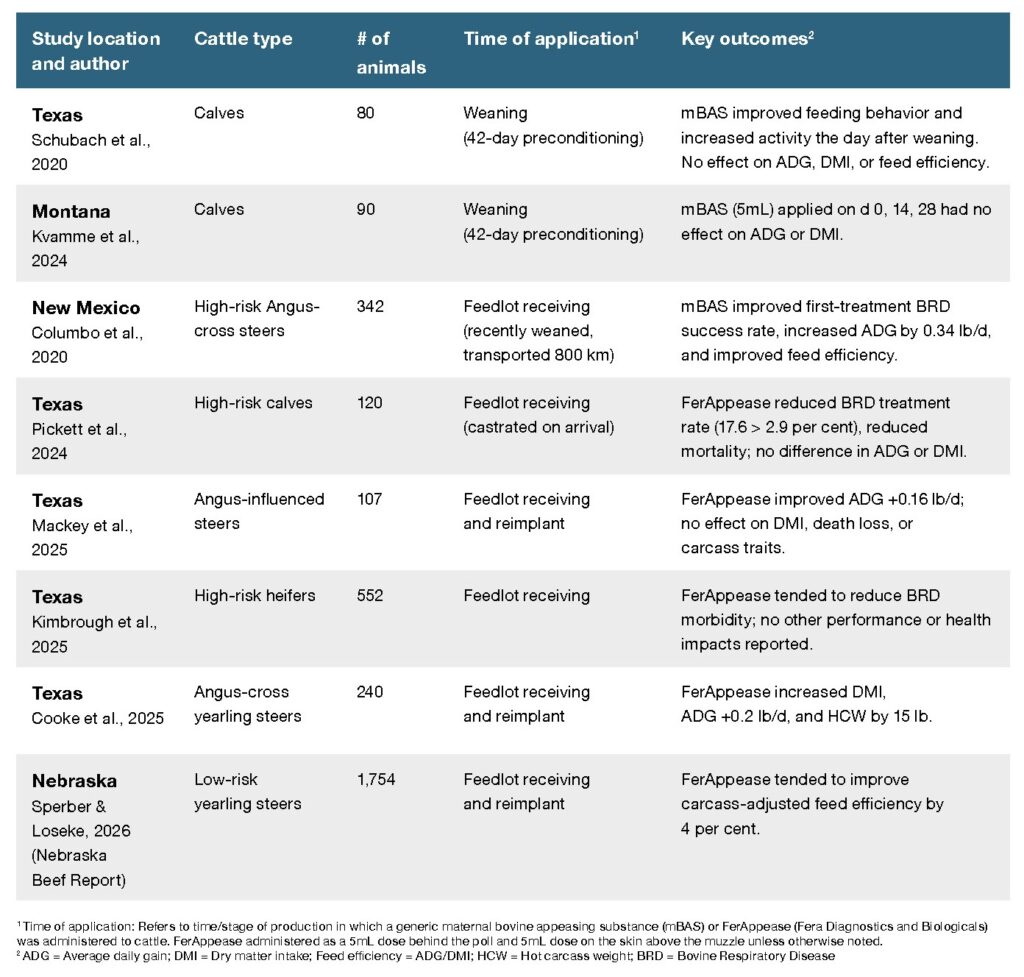
These studies show that context matters. The benefits of FerAppease seem most reliable in high-stress situations. Results are inconsistent in low-risk or more resilient cattle and the length of the positive response may be limited to the number of days that the product is active (7 to 14 days).
Cost-Benefit Considerations: Is it worth it?
At $3 USD per dose, a two-treatment program (arrival processing and reimplant) costs $6/head. Based on 2025 carcass prices: steers must gain at least 1.9 lb more HCW to break even. At lower cattle prices (i.e., 2018 cattle prices), break-even weight gain jumps to more than 3 lb HCW. In weaned calves, a $3 investment must yield ≥1 lb extra live weight—a modest but achievable target in some studies. While the economics may pencil out in high-stress groups, cattle responses are less certain in low-stress environments or yearlings. Producers should evaluate cost-effectiveness on a case-by-case basis, factoring in labour and timing.
Bottom Line: A tool with potential—but not a silver bullet
FerAppease is not a replacement for good stockmanship, nutrition, or vaccination. However, it has shown potential to reduce the physiological cost of stress on cattle and support better outcomes during key transitions. The product has validity at weaning, especially in high-risk calves and as a complementary tool at processing, when used alongside BRD control programs (such as Metaphylaxis). The product has less consistent results when used on low-risk cattle or in herds where margins are tight and extra cost must be closely monitored. Anecdotally, some producers have described reduced vocalization at time of weaning and quicker approach toward the feed bunk following a stressful event, such as branding or castration.
FerAppease represents a fresh approach to an old problem, but as with any emerging technology, adoption should be strategic—anchored in data, economics, and the specific needs of your cattle. For producers seeking to stack the deck in favour of animal well-being and performance, especially in challenging environments, FerAppease might offer a valuable edge—but only when the context is right.
This was first published in Volume 5 Issue 3 of ABP Magazine (Fall 2025). Watch for more digital content from the magazine on ABP Daily.
References: Colombo et al., 2020. doi:10.1083/jas/skaa339; Cooke et al., 2025. doi:10.1093/tas/txaf022; Kimbrough et al., 2024. https://wtamu-ir.tdl.org/items/5ff09ff4-23cd-4a6b-84fc-7421dd1a9d4c; Kvamme et al., 2024. doi:10.1093/jas/skae151; Mackey et al., 2025. doi:10.1016/j.vas.2025.100457; Pickett et al., 2024. doi:10.1093/jas/skae221; Schubach et al., 2020. doi:10.1093/jas/skaa278.613
Share this article on





Latest News
-
October 10, 2026 News
Federal funding to support farm safety programs across Canada
-
October 9, 2026 Current Markets & Forecasts
USDA lowers beef production forecasts as feed grain supplies grow
-
October 9, 2026 Checking in with ABP
Giving thanks to the people behind our food
Cattle Report
Updated: October 9, 2026
Steers
Live: ---
Rail: 495.00-500.00 del
Heifers
Live: ---
Rail: 495.00-500.00 del
Choice Steers
Live: 218.00 (IA, NE)
Rail: 345.00 (NE, IA)
Choice Heifers
Live: 218.00 (IA, NE)
Rail: 345.00 (NE, IA)
Boner Cows
Over 500 lbs: 268.04
Canadian Dollar
$70.27 0.26
Livestock Price Insurance Index
| Expiry | Fed | Feeder | Calf |
|---|---|---|---|
| 04-Jan-27 | -- | -- | -- |
| 01-Feb-27 | 288 | 456 | -- |
| 01-Mar-27 | 286 | 450 | -- |
| 29-Mar-27 | 290 | 448 | -- |
| 26-Apr-27 | 296 | 444 | -- |
| 24-May-27 | 304 | 450 | -- |
| 21-Jun-27 | 302 | 454 | -- |
Last Updated on October 8, 2026