Live: ---
Rail: ---

{{ weatherTemp }}°C
{{ weatherCity }}

AB Direct - Steers
AB Direct - Heifers
Live: ---
Rail: ---
Rail: ---
US Trade- Steers
Live: ---
Rail: ---
Rail: ---
US Trade - Heifers
Live: ---
Rail: ---
Rail: ---
Canadian Dollar
$72.34
0.07
0.07
April 22, 2026
Business Tools
Rotational Grazing: Extending the Grazing Season, Water Systems and Funding Opportunities
Rotational grazing offers more than just dividing pastures into smaller parcels. It can extend the grazing season, reduce winter feeding days, and make better use of forage resources on the farm. For producers, this can mean lower feed costs, improved pasture productivity, and in some cases, additional hay to sell.
Rotational grazing is widely adopted across Canadian beef operations. According to the 2021 Canada-wide Farm Environmental Management Survey, 74 per cent of beef producers use some form of rotational grazing, highlighting its role as a common forage management strategy.
Similarly, the Alberta AgriSystem Living Lab: 2022 Baseline Adoption Rates Survey found that, of 208 respondents, 69.2 per cent implemented rotational grazing during the 2022 season, managing 57.1 per cent of total reported pastureland under this system.
While adoption is relatively high, these results suggest rotational grazing is often applied to only a portion of available pasture acres.
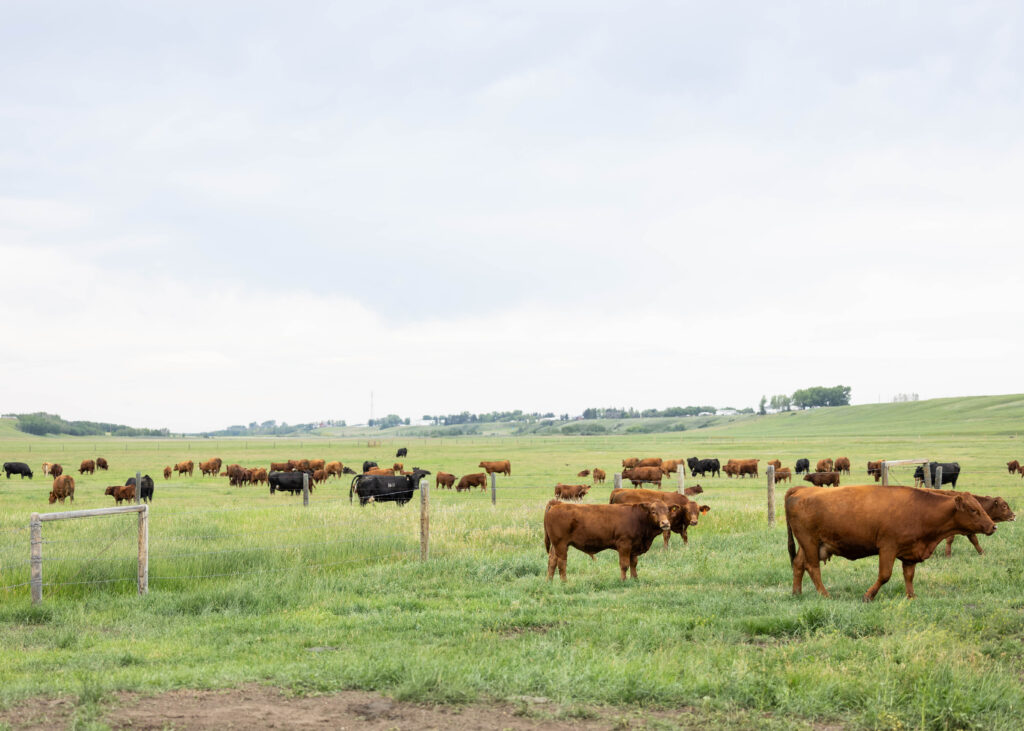
Patterns of use vary among producers. Most rotational grazing begins in May (44.7 per cent) or June (35.0 per cent), with October (51.2 per cent) the most common endpoint. The grazing period ranges from 48 to 244 days, averaging 145.3 days, which is not statistically different from the 135.6-day average reported for continuous grazing.
About half of producers (49.0 per cent) rest paddocks for 30–60 days between grazing events. Cattle movement is managed either on a set schedule (49.7 per cent) or based on forage availability (47.6 per cent). Among those using a schedule, the most common frequency is once per week (17.9 per cent) or every two weeks (11.7 per cent). The most common triggers for moving cattle are 50 per cent forage utilization (37.2 per cent) or 80 per cent utilization (35.9 per cent).
Despite widespread adoption, several barriers limit expansion. Nearly half of producers (48.4 per cent) identify water access as the primary challenge, while others point to up-front investment costs (10.9 per cent) and reluctance to use electric or portable fencing (9.4 per cent). These findings suggest that while rotational grazing is common, it is often constrained by infrastructure and resource availability.
Part 1: Do productivity gains pay for the infrastructure?
To evaluate rotational grazing, the COP Network developed scenarios for 11 benchmark farms using 2022 data. The analysis assumed producers invested in portable electric fencing in the first year to divide pastures into multiple paddocks, while continuing to use existing water systems. Because fencing costs are relatively similar across herd sizes, the per-cow cost is lower for larger operations.
Stocking rates were assumed to improve by 10 per cent under rotational grazing. However, producer experience and research suggest results can vary widely — from as little as 5 per cent to more than 60 per cent — depending on forage species, stand age, soil type, fertility, and moisture.
The primary benefit of rotational grazing was fewer winter feeding days, driven by increased pasture productivity and a longer grazing season.
For some operations, this also meant additional hay. If hay was sold in the baseline year, that surplus was treated as additional revenue; if not, it was carried forward as feed inventory.
What producers experienced
Across the 11 benchmark farms, only about half were able to recover the fencing investment within five years. Those that did shared three key advantages: larger herds, higher baseline feed costs, or additional revenue from hay sales.
Larger herds were able to spread fencing costs across more cows, reducing the investment per animal. Farms with higher feed costs — measured in dollars per head per day — saw greater savings from reducing winter feeding days. This was especially true for operations relying on purchased feed, where each additional grazing day lowered costs. Some farms also generated added revenue from selling surplus hay, while others improved resilience by carrying forage forward into the next season.
Smaller operations faced more challenges achieving payback within five years. However, where feed costs were high or surplus hay could be sold, rotational grazing still offered a meaningful return.
What it means on your farm
These results reinforce that rotational grazing is not a one-size-fits-all solution. Larger herds can recover costs more quickly because fencing expenses are spread across more animals, and farms with higher feed costs benefit more from each additional grazing day. Smaller herds may face longer payback periods, but can still see value under the right conditions.
Flexibility also plays a role. Producers who adopt lower-cost fencing systems or creative pasture layouts may improve their results. Understanding your own costs — both feed and infrastructure — is key to deciding whether rotational grazing makes sense for your operation.
Key takeaways
- Portable fencing is the largest upfront investment, with total costs similar across herd sizes
- Larger herds reduce the cost per cow
- Stocking rates were assumed to increase by 10 per cent, but actual results range from 5 to over 60 per cent
- About half of benchmark farms recovered fencing costs within five years
- Farms with higher feed costs saw the greatest savings
- Selling surplus hay can generate additional revenue, while others benefit from carryover feed
- Soil type, fertility, forage species, and stand age all influence outcomes
Part 2: Water that works harder
Adding a water system to rotational grazing is not just about convenience — it can also influence calf performance. While the upfront investment can be significant, cost-share programs may help offset some of the expense.
The setup: fences, pumps, and pipelines
The 2022 analysis examined six benchmark farms. Each added portable electric fencing, a solar-powered pump, and a shallow-buried pipeline system to support rotational grazing.
Key assumptions included:
- A longer grazing season through improved management
- Calves gaining an additional 0.09 pounds/day with improved water access
- Cost-share funding through the On-Farm Climate Action Fund (OFCAF), covering 70 to 85 per cent of eligible costs
The bottom line: gains and losses
Without funding, net benefits were generally negative over five years due to high upfront costs. This was especially challenging for farms with large pasture areas requiring long pipelines, or smaller herds where costs per cow were higher.
One exception saw positive returns driven by savings on purchased feed and fewer winter feeding days.
When OFCAF funding was applied, the economics improved. Four of the six farms were able to make the investment viable with reduced upfront costs.
Adding the benefit of heavier calves made the scenario profitable for most farms, although in some cases heavier weights shifted calves into lower-priced categories.
What it means on your farm
The feasibility of adding water systems depends on four key factors: upfront investment, herd size, feed cost savings, and potential revenue gains from heavier calves. For example, a 200-cow operation saving $20 per cow on feed could justify a $20,000 investment over five years.
Farms without existing water systems may see the greatest benefit, as improved water access can enhance calf performance in addition to grazing efficiency. Programs like OFCAF can reduce financial risk, but details vary by province, so it’s important to confirm eligibility and requirements locally.
Key takeaways
- Water systems can improve calf weights and reduce winter feeding days
- High upfront costs make investment challenging without funding
- Cost-share programs significantly improve feasibility
- Combined benefits — feed savings, funding, and heavier calves — drive profitability
- Herd size and per-cow savings determine what level of investment makes sense
Share this article on


Latest News
-
August 25, 2026 Checking in with ABP
ABP expands communications team to strengthen producer engagement
-
August 25, 2026 Checking in with ABP
Provincial Working Group on Traceability: Executive Brief #2
-
August 25, 2026 Inspiration
Recipe: Chili Lime Steak with Cilantro Rice and Watermelon Salad
Cattle Report
Updated: August 25, 2026
Steers
Live: ---
Rail: ---
Heifers
Live: ---
Rail: ---
Choice Steers
Live: ---
Rail: ---
Choice Heifers
Live: ---
Rail: ---
Boner Cows
Over 500 lbs: 326.11
Canadian Dollar
$72.34 0.07
Livestock Price Insurance Index
| Expiry | Fed | Feeder | Calf |
|---|---|---|---|
| 16-Nov-26 | 274 | 430 | -- |
| 14-Dec-26 | 276 | 414 | -- |
| 8-Feb-27 | 272 | 408 | -- |
| 8-Mar-27 | 270 | 406 | -- |
| 5-Apr-27 | 276 | 404 | - |
| 3-May-27 | 282 | 404 | -- |
Last Updated on August 20, 2026