Live: ---
Rail: 540.00 del

{{ weatherTemp }}°C
{{ weatherCity }}

AB Direct - Steers
AB Direct - Heifers
Live: ---
Rail: 540.00 del
Rail: 540.00 del
US Trade- Steers
Live: ---
Rail: ---
Rail: ---
US Trade - Heifers
Live: ---
Rail: ---
Rail: ---
Canadian Dollar
$72.56
0.09
0.09

February 10, 2026
Business Tools
Cool New Tools: A look at the Wandering Shepherd rumen bolus
An Alberta-developed multi-tasking sensor technology is starting to create some buzz in the livestock world.
Wandering Shepherd has generated interest in its wireless rumen bolus identification device close to home and as far away as Africa. In November, developers shared their pitch in the Ag Innovation Competition during Agri-Trade in Red Deer, where producers in attendance selected it as the People’s Choice award winner, worth the $5,000 prize cheque.
While rumen bolus sensor technology isn’t new, the Wandering Shepherd device has some unique features, according to co-founders Neil Helfrich and Sheldon Archibald.
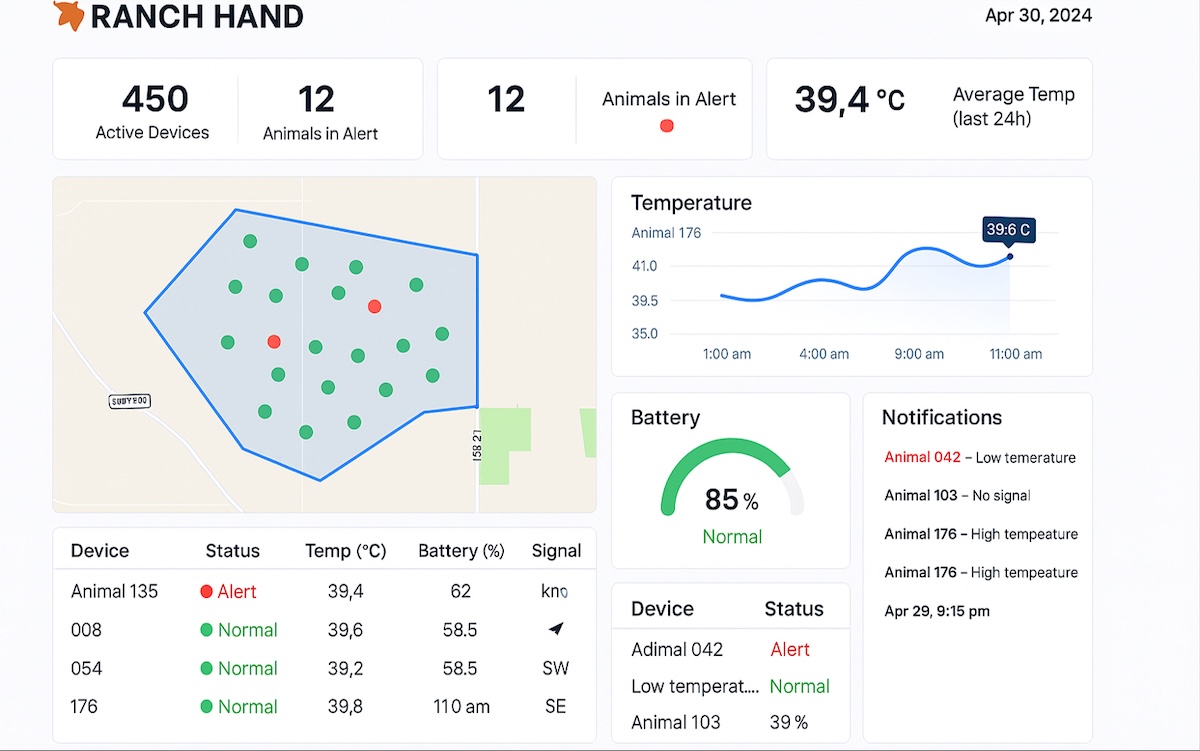
Not only can it provide electronic animal identification, but it also monitors rumen temperature, and that’s what Archibald considers the ‘game changer’ part of their innovation.
“From temperature, we can tell so much about the health of the animal,” explains Archibald, who is a rancher near Irma. “We can tell when it’s in the breeding cycle, when it’s in the calving cycle, when it’s ill and best of all, when it’s healthy. So designing the wireless rumen bolus to monitor animal health is wonderful.”
That’s attractive to all livestock producers, who grapple with the near-impossible realities of closely monitoring individual animal’s health…until they’re sick.
“One feature of our technology is that it monitors the temperature of the animal and sends it once every hour. When there is a temperature spike, it increases to every 30 minutes, and when it’s a high temperature spike, it increases to every 15 minutes,” adds Archibald.
Helfrich goes on to explain the increased notifications once the temperature has risen still gives producers some reaction time.
“And the reason behind this is so that if a rancher like Sheldon starts getting a notification in calving season about cow number 156 every 15 minutes, he knows it’s in the later stages of the calving process. So, it gives him time to go out and check on the cow to make sure that there’s no complications,” says the Sherwood Park inventor and Wandering Shepherd CEO.
Co-founder Archibald is primarily a cow-calf producer, but he also has purebred seedstock, and has found the device a real time and labour saver when it comes to detecting heat cycles for AI work.
Both concepts have gotten rave reviews in testing and showcasing the technology with the American Farm Bureau, as the bolus helps address a universal challenge in agriculture.
“Every rancher, cattleman, farmer, anybody in the ag business always says we’re so short of help. It’s hard to find good help. It’s family operations running this still and trying to do everything you need to do,” says Archibald.
Current identification and health monitoring technology on eartags has been effective, but retention is always something to contend with—not so with a rumen bolus.
Helfrich, who actually worked on earlier technology for electronic identification of eartags, says it’s taken them a lot of testing and countless prototypes to deal with challenges like signal strength and battery life. That’s actually how he and his distant cousin Archibald got reconnected and working together.
“It’s finding that middle ground, where the signal is strong enough to penetrate through the animal, but not so strong that it drains the battery too quickly. The one thing about ours compared to the competitors is it’s about half to one-third the size, but our battery life is actually double,” says Helfrich, who estimates a Wandering Shepherd bolus battery could last 10 years.
The technology’s unique design means the bolus stays upright in the rumen, to give the most accurate reading of information.
“It’s designed like a weeble wobble, and the reason for that is so the signal travels outward of the animal, and actually has better chance of being picked up by our network. We actually have a patent on that.”
Wandering Shepherd can also do location of animals through the bolus, which is unique to their system. Rumen bolus identification has been focused on the dairy business in the past, where producers are more hands-on with the animals. But Helfrich and Archibald are focused on beef cattle, although the device is small enough for sheep and goats as well. They’ve already had some large-scale feedlot operators eager to implement the technology, which also can transmit larger distances to smaller receivers, or even by satellite.
The location tracking is what has caught the attention of Africa, where producers have no real identification and when animals are stolen there’s no way to prove ownership. Helfrich is working on adding facial recognition abilities to the package as well, which he believes would discourage cattle rustling, as the bolus couldn’t be tampered with like a brand, or eartag.
Helfrich and Archibald have done a lot of their farm validation and testing of the product south of the line. In fact, after a positive reception at an American Farm Bureau convention in Utah, they were invited to a Top Producer Summit in Kansas, which led them to finding a building in Kansas, in the heart of the midwestern cattle belt, to set up production. The electronics will be manufactured in Edmonton and shipped to Kansas for the final assembly of the device. Archibald is finding the most common question from producers is how soon they can get product. While Wandering Shepherd takes on the manufacturing center January 1st, it will still be a while before the smart bolus hits the marketplace.
While economics in the cattle business is always uppermost, the high price of animals now puts technology costs in a different light. A device that could help prevent the loss of a high-priced heifer can pay for itself quickly.
“This is a pretty cool technology for the young cattlemen, giving them the ability to do other things and check their cattle remotely,” says Archibald. “But the interesting thing is we’ve had some older cow-calf producers comment their 10-year-old grandson could check the herd in the morning before he goes to school and let them know where the problems are. And we had another fellow in Nebraska tell us ‘If I had this in my cattle, I could leave the farm for a week and go to the NFR, and my neighbour kid could check them from his tablet.’”
For more information, head to wanderingshepherd.com.
This was first published in Volume 5 Issue 4 of ABP Magazine (Winter 2025). Watch for more digital content from the magazine on ABP Daily.
Share this article on



Latest News
-
March 25, 2026 Checking in with ABP
Veterinary and Medicine Costs: Are you getting results?
-
March 24, 2026 Checking in with ABP
2026 Grazing lease rates explained
-
March 24, 2026 Checking in with ABP
4-H Alberta programs and scholarships offer new opportunities for youth this spring
Cattle Report
Updated: March 26, 2026
Steers
Live: ---
Rail: 540.00 del
Heifers
Live: ---
Rail: 540.00 del
Choice Steers
Live: ---
Rail: ---
Choice Heifers
Live: ---
Rail: ---
Boner Cows
Over 500 lbs: 320.80
Canadian Dollar
$72.56 0.09
Livestock Price Insurance Index
| Expiry | Fed | Feeder | Calf |
|---|---|---|---|
| 15-Jun-26 | 310 | 468 | -- |
| 13-Jul-26 | 304 | -- | -- |
| 10-Aug-26 | 300 | 464 | -- |
| 07-Sept-26 | 294 | 464 | -- |
| 05-Oct-26 | 292 | 464 | 576 |
| 02-Nov-26 | 282 | 456 | 572 |
| 30-Nov-26 | 282 | 448 | 572 |
Last Updated on March 19, 2026