Live: ---
Rail: ---

{{ weatherTemp }}°C
{{ weatherCity }}

AB Direct - Steers
AB Direct - Heifers
Live: ---
Rail: ---
Rail: ---
US Trade- Steers
Live: ---
Rail: ---
Rail: ---
US Trade - Heifers
Live: ---
Rail: ---
Rail: ---
Canadian Dollar
$73.76
0.10
0.10
March 10, 2026
Checking in with ABP
Beyond Bull Selection: Other Factors Affecting Calf Birth Weights
We have all been there, two in the morning pulling a huge calf out of a cow that really shouldn’t have had this problem. The bull had a low birth weight EPD so what went wrong?
Genetic heritability of birth weight accounts for about 45 per cent with the remaining 55 per cent being caused by environmental conditions. The bull plays a smaller part than the cow, with the general rule being that the calf will weigh at birth about seven to eight per cent of its mother’s body weight. Larger framed cows will on average have larger calves than more moderate cows.
Long cold winters also impact birth weight. According to a long-term study conducted by the University of Nebraska (Deutscher et al., 1999) the temperature during the last three months of gestation will impact the birth weight. Expect a pound more for each degree below average winter temperature and an increase of calving difficulty by 2.6 percentage points per additional pound. This is because the cow’s body keeps more of the blood flow to her core during cold times increasing the nutrients being carried to the calf. The same holds true for summer and fall calving herds as the calves will be smaller due to the blood flow being kept near the extremities to keep the cow cooler.
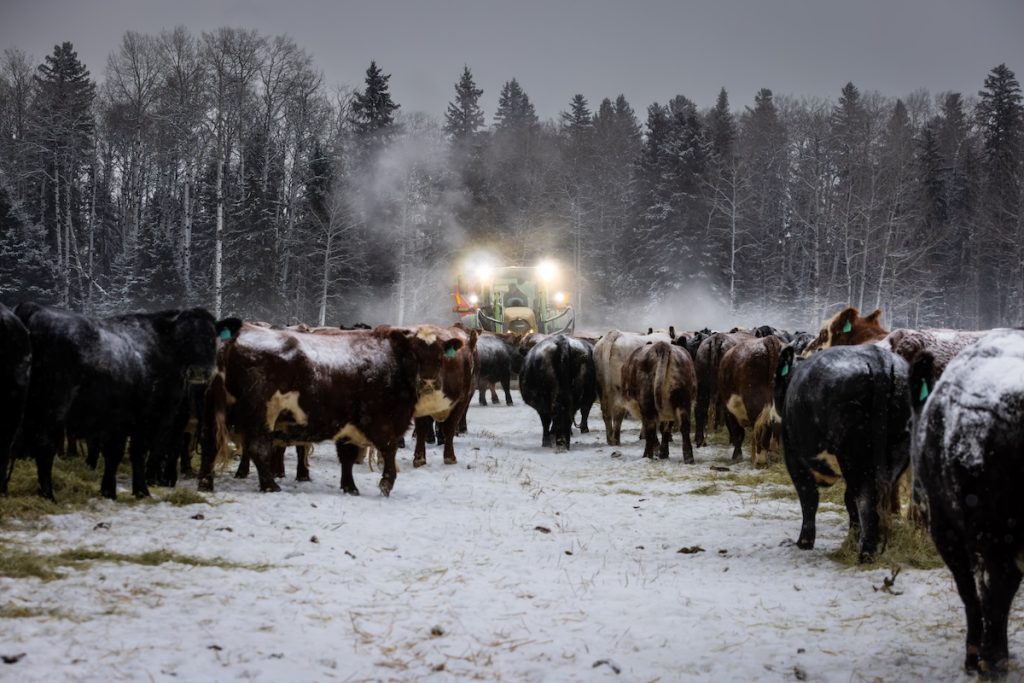
According to this study many other factors also affect calf birth weight and calving difficulty, including cow age, her weight, body condition, nutrition, cow pelvic size, genetics, gestation length and calf sex.
A study conducted by the University of Saskatchewan’s Western College of Veterinary Medicine analyzed 29,970 full term births from 203 privately owned cow–calf herds across Alberta, Saskatchewan, and Northeastern British Columbia during the 2002 calving season. The lowest risk of calving problems was found in mature cows (5–10 years old), while dystocia increased in twin births, male calves, and calves born earlier in the season (December to February).
One of the key findings from this Canadian field study was that pre-calving body condition score (BCS), measured on a 9 point scale, strongly influenced stillbirth and dystocia risk. After accounting for other risk factors, including assistance at calving, cows with a BCS of 3 or 4 were more likely to have calves dead at or within one hour of birth compared with cows calving at a BCS of 5. Cows with a high BCS (6–7) before calving were more likely to experience severe dystocia than cows calving at BCS 5. A gain in BCS from pregnancy testing to calving was associated with lower odds of dystocia, suggesting that cows on an improving nutritional plane experienced fewer calving difficulties.
This study identified additional stillbirth risk factors: twin pregnancies; retained placenta; uterine prolapse; low precipitation during the previous growing season, which affects forage quality; and early season calving. Using birth records from the previous year, the study found that if a cow or heifer had experienced a difficult birth or a hard pull, her risk of calving issues—including stillbirth—was greatly increased in the following year.
The age of the cow has a profound effect on incidence of calving difficulty. Findings from the Western Canadian study showed that replacement heifers had about 6.5 times the odds of needing assistance compared with mature cows, while second and third-calving cows had 1.6 and 1.24 times the odds, respectively. For severe dystocia, heifers had 4.6 times the odds of mature cows, with progressively lower risk in second and third parity cows. Stillbirth risk was also higher in both first calf heifers and cows over 10 years of age compared with mature cows.
Pelvic size also matters. Gene Deutscher, extension beef specialist with the University of Nebraska, authored Beef Handbook Bulletin BCH 2130, Pelvic Measurements for Reducing Calving Difficulty. He stated, “Calving difficulty results in a major economic loss to beef producers.”
Large framed cows tend to have wider pelvic areas but also carry proportionately heavier calves, which offsets any advantage. Selecting a cow on size alone seems ineffective. Heifers with small pelvic areas have an 85 per cent difficulty rate compared to those with larger pelvises. He recommends obtaining pelvic measurements before breeding; a 600-pound heifer should have a pelvis that measures at least 11 centimeters wide and 12 centimeters high to deliver a 63-pound calf.
Calving difficulty increases calf death loss, cow mortality, labor and veterinary costs. It delays the return of estrus to cows and reduces conception rates. It also results in lower calf weaning weights and market values from breeding young heifers to easy calving bulls to reduce calving difficulty. Studies have shown that calf losses of four per cent within 24 hours for unassisted births jump to 16 per cent for calves requiring birth assistance. As producers select bulls for more growth, larger calves at birth and more calving difficulties can be expected.
“Gestation lengths also affect the calf size in the last few days of the gestation,” says Rolland Kramer, D.V.M., Stockman’s Veterinary Clinic in North Platte, Nebraska. “A calf will gain between a pound and a pound and half a day, so just a couple of days will add five pounds to the calf. There are gestation length variations between cattle breeds and also within breeds. Gestation length is a maternal trait, cows that tend to calve early will pass that trait onto their daughters.”
He also mentioned fetal programming studies showing the impact maternal nutrition has long-term on the calf, both for replacement heifers and even how the feeder carcass will yield. A cow’s body condition score especially in early gestation makes a huge difference on the calf.
A Beef Cattle Handbook bulletin (BCH-2120), authored by Harlan D. Ritchie of Michigan State University and Peter T. Anderson of the University of Minnesota, cited a long-term study with a group of Hereford cows that were moved from Miles City, Montana to Brooksville, Florida and the Florida herd was moved to Montana. Ten years later the birth weights of the Montana herd that had been moved south had declined from 81 pounds to 64 pounds. The birth weights of the relocated Florida herd increased from 66 pounds to 77 pounds. This supported other studies that calves of comparable genotypes will be born lighter in the south than in the north.
Kalyn Waters, former SDSU Extension Cow/Calf Field Specialist, in Factors Affecting Birth Weight (3/25/2013) said restricting maternal nutrition to decrease birth weight is not a sound management practice. Extreme feed reductions such as feeding less than 70 per cent of the cow’s nutritional requirements will result in a smaller calf but increases calving problems as the cows are too weak and undernourished to deliver the calf and her milk supply and quality are greatly affected.
Pete Anderson, Extension Beef Cattle Specialist, authored a paper for the University of Minnesota Extension: Minimizing Calving Difficulty in Beef Cattle (2012). His conclusions are: “Mate virgin heifers and small cows to bulls that will sire small calves. Feed heifers well enough to weigh at least 85 per cent of their expected mature weight at first calving. Use pelvic measurements and do not retain daughters of cows that have a record of calving difficulty. Begin breeding heifers 21 to 30 days earlier than cows so they can be observed, and feed late in the day. Record a calving ease score for all calves that are observed at birth.”
Purebred producers record birth weight and calving ease on their calves which is something commercial producers might also implement for their own records. Our goal as beef cattle producers is to have unassisted births and a high breed back ratio so considering all the factors affecting calf birth weight is important in our business.
This was first published in Volume 6 Issue 1 of ABP Magazine (February 2026). Watch for more digital content from the magazine on ABP Daily.
Leave a Comment
Latest News
-
March 10, 2026 Checking in with ABP
Beyond Bull Selection: Other Factors Affecting Calf Birth Weights
-
March 9, 2026 Checking in with ABP
Government Relations and Policy Update
-
March 9, 2026 Checking in with ABP
Canfax Weekly Article | Report for the week of March 9, 2026
Cattle Report
Updated: March 10, 2026
Steers
Live: ---
Rail: ---
Heifers
Live: ---
Rail: ---
Choice Steers
Live: ---
Rail: ---
Choice Heifers
Live: ---
Rail: ---
Boner Cows
Over 500 lbs: 316.84
Canadian Dollar
$73.76 0.10
Livestock Price Insurance Index
| Expiry | Fed | Feeder | Calf |
|---|---|---|---|
| 01-Jun-26 | 310 | 472 | -- |
| 29-Ju-26 | 308 | 464 | -- |
| 27-Jul-26 | 302 | -- | -- |
| 24-Aug-26 | 296 | 466 | -- |
| 21-Sep-26 | 292 | 466 | 582 |
| 19-Oct-26 | 290 | 464 | 586 |
| 16-Nov-26 | 282 | 456 | 584 |
Last Updated on March 5, 2026


Add abpdaily.com to your home screen
Tap the menu button next to the address bar or at the bottom of your browser.
Select ‘Install’ or ‘Add to Homescreen’ to stay connected.
Share this article on
About the Author
Deanna Nelson-Licking grew up in Southern Idaho but now lives in central Nebraska with her husband and four children. She has been a freelance contributor to various agricultural media platforms including ABP Magazine.