Live: ---
Rail: ---

{{ weatherTemp }}°C
{{ weatherCity }}

AB Direct - Steers
AB Direct - Heifers
Live: ---
Rail: ---
Rail: ---
US Trade- Steers
Live: ---
Rail: ---
Rail: ---
US Trade - Heifers
Live: ---
Rail: ---
Rail: ---
Canadian Dollar
$70.44
0.17
0.17
August 27, 2026
Health & Production
Alberta moisture conditions remain uneven as harvest progresses
Moisture conditions across Alberta remain highly variable heading into harvest, with some areas dealing with excess moisture while others continue to see below-normal rainfall and declining soil moisture reserves.
Alberta Agriculture and Irrigation’s latest moisture update shows rainfall during the week ending August 20, 2026, was lighter than in previous reporting periods. The heaviest precipitation occurred in parts of southern Alberta, where portions of Bighorn, Foothills, Ranchland, Pincher Creek, Willow Creek, and Cardston municipalities recorded between 25 and more than 50 millimetres of rain. Meanwhile, some areas in Newell County, Cypress County, Acadia Valley, and Special Area No. 2 saw less than 10 mm.
Despite the lighter rainfall, moisture accumulated since the start of the growing season remains at or above average across much of Alberta. Large portions of the Peace, North West, Central, and South regions have received roughly 90 to 150 per cent of their typical season precipitation.
Not all areas have benefited equally. Part of Cypress, Forty Mile, Rocky View, Clearwater, Bighorn, Mountain View, Kneehill, Red Deer, Yellowhead, Big Lakes and Lesser Slave River continue to trail historical averages, receiving about 70 to 90 per cent of normal precipitation since the season began.
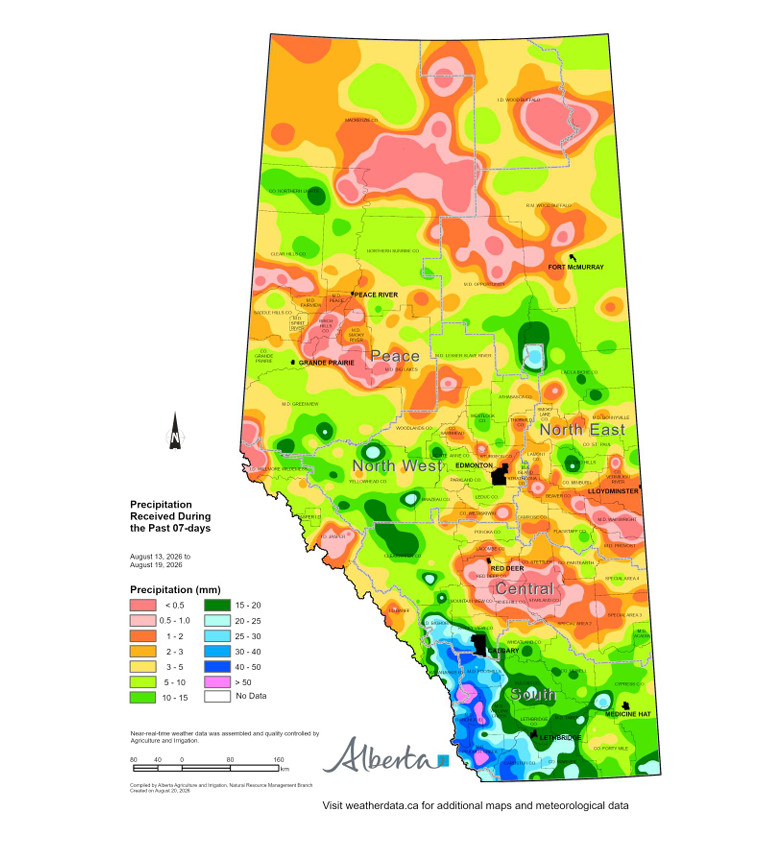
Much wetter conditions persist farther north and east. Seasonal precipitation totals in parts of east-central and northeastern Alberta range from 130 to 250 per cent of average, with municipalities including Leduc, Parkland, Lac Ste. Anne, Sturgeon, Westlock, Lamont, Thorhild, Beaver, Two Hills, St. Paul, Smoky Lake, Lac La Biche, and Bonnyville among the wettest areas.
The report notes rainfall totals in some of those municipalities are so unusual that similar amounts would typically be expected less than once every 50 years.
The ongoing wet weather has created significant challenges for producers and has contributed to agricultural disaster declaration sin municipalities including Beaver, St. Paul, Bonnyville, Smoky Lake, Thorhild, Westlock, Sturgeon, and Wetaskiwin.
Moisture stored in the soil also varies considerably across the province. Recent rainfall boosted conditions in southern Alberta, while reserves declined in parts of central Alberta. Drier conditions have taken hold in areas including Wainwright, Provost, Stettler, Wheatland, Starland, Red Deer, Mountain View, and Clearwater.
At the same time, some of Alberta’s strongest moisture reserves remain concentrated in the northern Central and North East regions. Areas within Sturgeon, Strathcona, Lamont, Thorhild, Smoky Lake and Two Hills counties are carrying substantially more soil moisture than is typical for this time of year.
The Peace Region has also become drier in recent weeks, with moisture shortages becoming more widespread in municipalities such as Greenview, Grande Prairie, Spirit River, Fairview, and Clear Hills.
Share this article on




Latest News
-
October 7, 2026 News
Harvest progress jumps as Alberta producers make up ground
-
October 7, 2026 Health & Production
What producers should know about nitrates in forage
-
October 6, 2026 Checking in with ABP
Alberta cattle markets remain strong and steady
Cattle Report
Updated: October 7, 2026
Steers
Live: ---
Rail: ---
Heifers
Live: ---
Rail: ---
Choice Steers
Live: ---
Rail: ---
Choice Heifers
Live: ---
Rail: ---
Boner Cows
Over 500 lbs: 267.77
Canadian Dollar
$70.44 0.17
Livestock Price Insurance Index
| Expiry | Fed | Feeder | Calf |
|---|---|---|---|
| 25-Jan-27 | 286 | 460 | -- |
| 22-Feb-27 | 286 | 452 | -- |
| 22-Mar-27 | 288 | 450 | -- |
| 19-Apr-27 | 294 | 446 | -- |
| 17-May-27 | 300 | 452 | -- |
| 14-Jun-27 | 304 | 456 | -- |
| - | - | - | - |
Last Updated on October 1, 2026