Live: ---
Rail: ---

{{ weatherTemp }}°C
{{ weatherCity }}

AB Direct - Steers
AB Direct - Heifers
Live: ---
Rail: ---
Rail: ---
US Trade- Steers
Live: ---
Rail: ---
Rail: ---
US Trade - Heifers
Live: ---
Rail: ---
Rail: ---
Canadian Dollar
$72.73
0.14
0.14
December 29, 2025
Health & Production
Controlling gophers with ecosystem-inspired solutions
Beef producers in Alberta are known for being stewards of the grasslands. While cattle are part of a greater ecosystem, species like gophers can pose management challenges to producers. Fortunately, solutions to gopher problems can be found within nature’s own patterns.
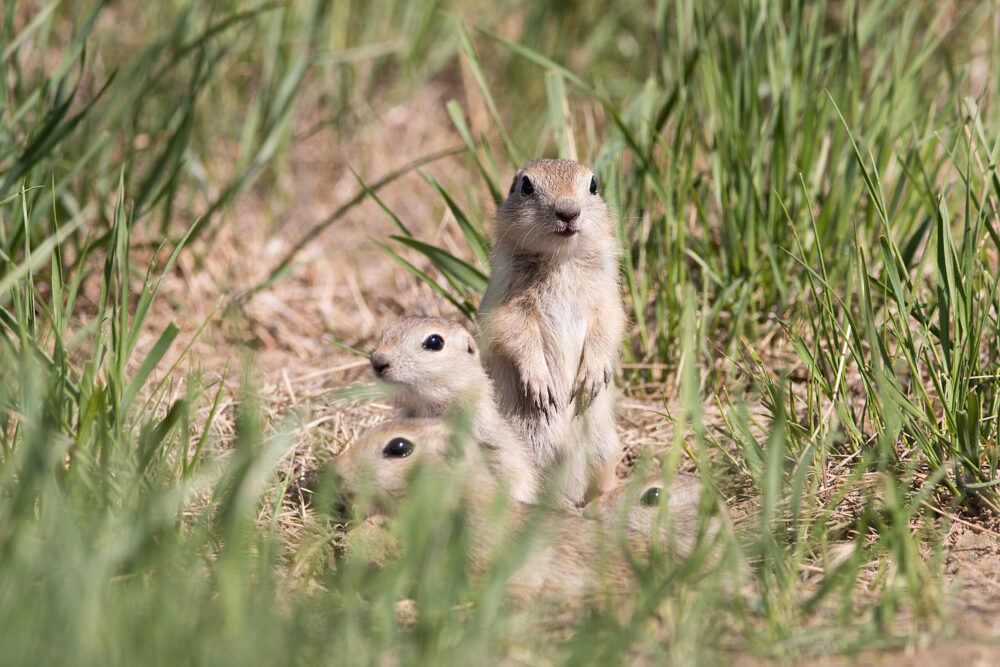
Richardson’s ground squirrels, more commonly known as gophers, are native to Alberta. While they can cause challenges, gophers are a keystone species, meaning they play a vital role in the prairie ecosystem. Besides being prey for grassland predators, gophers also dig burrows that provide habitat for other species, such as the endangered burrowing owl.
However, when natural patterns slip out of balance, gopher populations can grow out of control. Brad Downey, Senior Biologist at the Alberta Conservation Association, notes that we are currently seeing “an explosion of gopher populations”, particularly in southern Alberta. With several major predators listed as species at risk in Alberta, predation on gophers is limited, Downey explains. Extensive gopher populations can also threaten grassland birds because of predation on nests.
“Right now, we’re in the perfect storm for gophers,” says Graydon Garner, Environment and Climate Change Coordinator for the Canadian Cattle Association. “Drought conditions over the past 5 to 10 years have created shorter vegetation that offers more open spaces for gophers to come in. We have fewer managers out there on the landscape with less time and ability to manage the problem.”
When gopher populations reach extremes, producers experience greater losses that make control critical. “The main issue with gophers in the cattle industry is loss of forage,” says Garner. “Gophers, being herbivores, will eat grass. At today’s calf prices, the value of every blade of grass that a gopher eats is so much higher.”
Research from the University of California, Berkeley determined that gophers eat an average of 119 grams of forage dry matter per kilogram of body weight every day. With just 32 gophers on a single acre, that translated to an eight per cent loss of forage. In drought-ridden areas where grass and hay are already scarce, gopher consumption can amount to huge losses for beef producers. With gopher populations on the rise in Alberta, beef producers are looking for ways to protect their precious forage resources. In 2020, the Pest Management Regulatory Agency began implementing a phase-out of liquid strychnine for gophers, with use banned as of March 4, 2023. The decision was driven by concerns around the poison being compounded in non-target predator species scavenging on poisoned gophers, such as hawks and even producers’ own working dogs.
Fortunately, several options for managing gophers lie in the natural patterns of grassland ecosystems. One of the main control methods available is encouraging natural predators to occupy pasture and hay land. Just by encouraging natural predators, producers can make a big impact. “A pair of ferruginous hawks will eat up to 500 gophers during the nesting season,” says Brad.
“If you don’t have great existing habitat for hawks, you can install hawk poles,” explains Garner. “These are small rectangular platforms mounted on telephone poles to provide nesting or perching spots for hawks, raptors, eagles, or other large birds that prey on Richardson’s ground squirrels.”
A pair of ferruginous hawks will eat up to 500 gophers during the nesting season.
Installing hawk poles comes with a few considerations. “Ideally, producers put up these nesting sites before March when hawks start coming back,” says Downey. “You can either put a pole into the ground or mount the pole to a corner post.” Downey explains that nesting platforms should be about 10-12 feet off the ground, with poles at least a mile apart, since most hunting occurs within 800 metres of the nest.
Beyond managing gophers, creating good habitat for predatory birds is a success story for the beef industry. “Encouraging predator habitat is something the beef industry has already done a great job of,” says Downey. “In the early 2000s, our ferruginous hawk population was around 600 pairs, and thanks to the ranching industry and a lot of landowners, there are now more than 1,400 pairs in the province.”
Other land animals can also be effective controls for gophers, such as snakes and weasels. Downey encourages producers to maintain trees and shrubs along field perimeters to create corridors for these species.
Badgers are another major predator for gophers but encouraging them to burrow in pasture and hay lands comes with a few more challenges. “Badgers are a very effective predator,” says Garner. “However, they come with increased damage to the ground, which can be a real hazard for folks using horses, machinery, or for cattle themselves.”
If producers can tolerate the implications of badgers on the landscape, they can have a massive impact on local gopher populations. Research indicates that badgers will eat two to three gophers each day, reducing the local population by half before migrating to a new gopher colony. Badgers will even eat gophers over the winter months while they are in torpor, similar to hibernation, underground. Like gopher holes, badger burrows also provide habitat for other grassland species, providing other ecosystem benefits.
As Downey explains, encouraging wildlife to stick around relies on more than just one parcel of land. “Maintaining connected corridors is important to attracting those natural predators,” he says. Working with neighbors to create wildlife habitat across a larger tract of land will create a more interconnected area of habitat that will better encourage wildlife to inhabit a target spot for gopher control.
Another method of gopher control involves managing the height of forages. “There have been a number of studies that show gopher numbers are reduced in taller grass (15cm, 30cm),” says Downey. “Gophers like to stand up and see what’s around them, so they need shorter grass to do that.” Producers can manage grazing or plant specific species to encourage a taller forage stand that discourages gopher colonization.
For producers experiencing gopher issues on cropland, Downey notes that growing a buffer of oats or wheat around the edge of a crop can “create a dense barrier” that discourages gophers from getting into a higher value crop like canola.
Of course, certain forages aren’t suited to maintaining taller forage stands, particularly on native grasslands. “It’s up to producers to decide if they see a value in this practice and determine if they can manage it on their unique landscape,” says Garner.
A final option for gopher control is shooting, although it is worth noting that this option requires the most time and effort for the producer. Downey notes that shooting can be effective, but timing is critical to ensuring its effectiveness.
“I always tell landowners that if they are shooting gophers, to make sure they do it in February or March,” says Downey. “In April and May, the gopher population is going to explode by roughly eight times when females have their litters. If you hunt in February and March, you will have much more of an impact.”
Both Downey and Garner encourage producers to use multiple methods to develop an integrated pest management strategy that supports population control year-round. The specific combination of strategies will look different for each producer, and Downey notes that producers will have the best idea of their own land to capitalize upon predators and other control options that are already present.
While stewardship solutions are an important part of an overall strategy for gopher control, they take time to be effective. Predators won’t inhabit land overnight, and producers need methods to control gopher populations in the short term as populations overrun their land. Garner explains that while there are some alternative poison options out there on the market, such as zinc phosphide, “specific scientific research on gophers in Canada is lacking”. Industry groups like Alberta Beef Producers and the Canadian Cattle Association are advocating for producers to have all options on the table, with a focus on methods that are scientifically proven to be effective in a timeline that is practical for producers.
Producers looking for more information on gopher control options are encouraged to engage with their local forage and grazing associations, which often host extension events on this topic. The Government of Alberta also offers a fact sheet on gopher control methods, including details about gopher life cycles to help optimize the timing of control. The Alberta Conservation Association can help producers with advice on how to set up infrastructure like hawk poles.
This was first published in Volume 5 Issue 3 of ABP Magazine (Fall 2025). Watch for more digital content from the magazine on ABP Daily.
Share this article on


You might also be interested in
-
April 27, 2022 Issues & Insights
Wild pig distribution and eradication on the prairies
Cattle Report
Updated: March 25, 2026
Steers
Live: ---
Rail: ---
Heifers
Live: ---
Rail: ---
Choice Steers
Live: ---
Rail: ---
Choice Heifers
Live: ---
Rail: ---
Boner Cows
Over 500 lbs: 318.14
Canadian Dollar
$72.73 0.14
Livestock Price Insurance Index
| Expiry | Fed | Feeder | Calf |
|---|---|---|---|
| 15-Jun-26 | 310 | 468 | -- |
| 13-Jul-26 | 304 | -- | -- |
| 10-Aug-26 | 300 | 464 | -- |
| 07-Sept-26 | 294 | 464 | -- |
| 05-Oct-26 | 292 | 464 | 576 |
| 02-Nov-26 | 282 | 456 | 572 |
| 30-Nov-26 | 282 | 448 | 572 |
Last Updated on March 19, 2026