Live: ---
Rail: 545.00 del

{{ weatherTemp }}°C
{{ weatherCity }}

AB Direct - Steers
AB Direct - Heifers
Live: ---
Rail: 545.00 del
Rail: 545.00 del
US Trade- Steers
Live: ---
Rail: ---
Rail: ---
US Trade - Heifers
Live: ---
Rail: ---
Rail: ---
Canadian Dollar
$72.06
0.14
0.14
April 2, 2026
Checking in with ABP
Incorporating the leptin gene in breeding and feedlot decisions
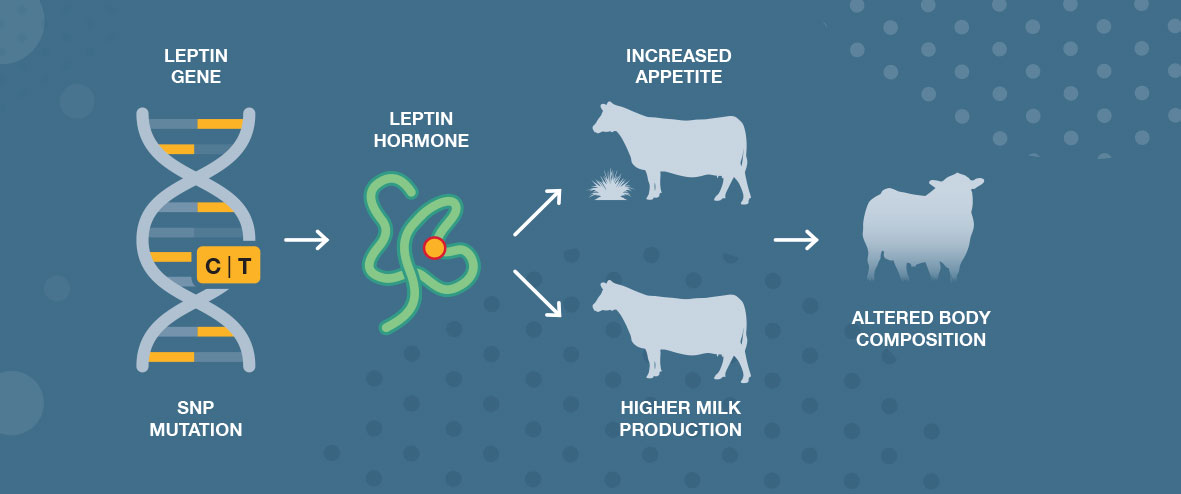
The leptin gene in mammals is called the obese gene and was first discovered in mice.
This gene produces a protein/hormone created by fat cells. The hormone signals the brain to regulate hunger and body weight, and is often called the “satiety hormone” because it helps you feel full and tells your body it has enough stored energy so you can stop eating.
In humans and animals, leptin helps maintain a specific body weight by regulating appetite and energy expenditure. When body fat decreases, leptin levels fall, signaling increased hunger and lower energy expenditure to prevent further fat loss.
In cattle, this gene and the hormone it produces regulates metabolism, fat deposition, and affects reproduction. Variations in this gene are associated with important production traits, including milk yield, milk fatty acid composition, and beef quality like marbling and back fat thickness. DNA sequence variations (alleles)—at the same gene location can be potential markers for genetic selection to improve cow herds and the calves produced, and some feedlots use these tests to determine the performance potential of cattle. The three possibilities for leptin are homozygous “normal” (CC) without leptin, homozygous mutant (TT), and heterozygous (CT).
Leigh Marquess, President of Quantum Genetix Canada Inc. (a company that researches and provides genetic testing services), says variations in important production traits are important for feed yards, purebred breeders and commercial cow-calf producers as well as dairies.
“The main function of the hormone produced by the leptin gene is to optimize longevity,” he says.
“This hormone circulates in the blood and goes to the hypothalamus (in the brain) which modulates food intake and metabolism to ensure a long and healthy life. If the brain doesn’t see enough leptin in the blood, when the body doesn’t have much fat and is starving, it signals for more appetite—to increase intake—and reduces metabolism, to try to build fat stores. This helped cattle survive.”
“Researchers found, first in mice, then in nearly every mammal, that there can be mutations in these genes,” says Marquess. This can make a difference in how cattle perform in terms of feed consumption.
In the feedlot
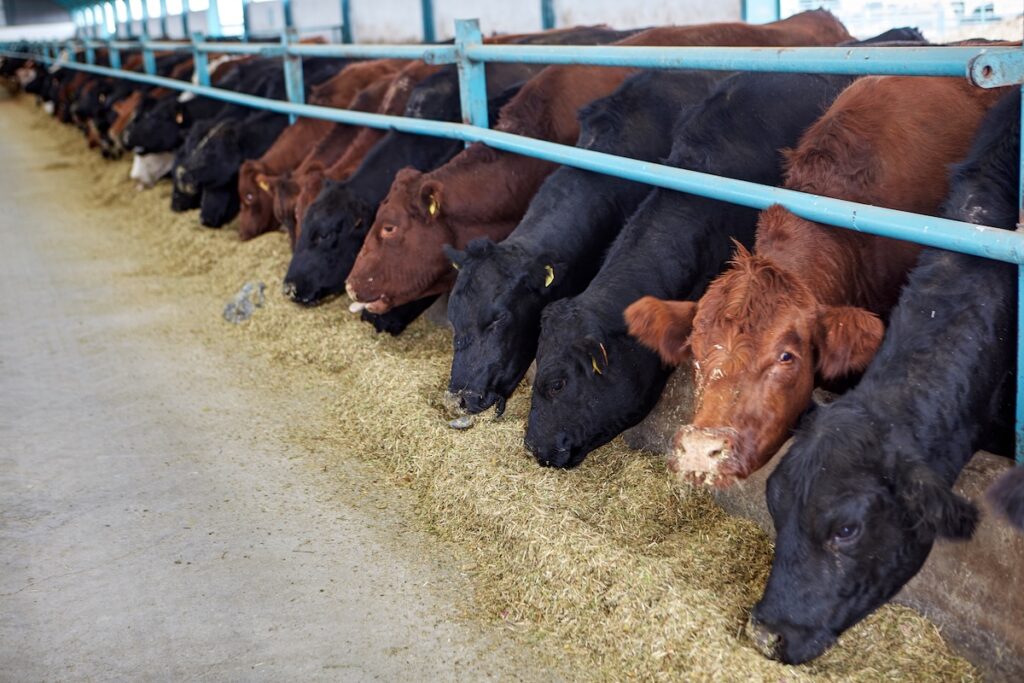
“Let’s say we have two steers in a feedlot that each weigh 1500 pounds. They are fat, eating a lot of corn, barley, etc. One has a mutation in that gene and one doesn’t. In the one that’s normal (without the mutation) the body does its best to regulate intake and metabolism. That’s one reason why toward the end of the feeding period when animals become fat, you’ll see intake decrease,” says Marquess. They don’t continue to gain as much weight.
“We try to overcome those hormonal feedback mechanisms, and nutritionists do an excellent job of counteracting this situation. In an animal with the mutation, however, it changed the structure of the hormone. There is a lot of hormone circulating but the brain can’t see it, and thinks the body is still in a time of scarcity as opposed to a time of plenty, so the animal keeps eating,” Marquess says.
“The animal with that genotype for leptin will have about 10 more pounds of carcass weight if killed in exactly the same conditions as the normal animal. It ate about one pound more of dry matter per day and produced more carcass weight, along with subcutaneous fat and intramuscular fat—more marbling and more back fat.”
There are differences in marbling and back fat.
The grading systems in the U.S. and Canada reward more marbling and penalizes too much back fat. “But if the body has more energy than needed for maintenance it puts it into storage like subcutaneous fat. It’s difficult to achieve extra marbling without the other fat storage,” says Marquess.
There are breed differences in marbling and back fat. Wagyu have very little back fat (subcutaneous fat) and look lean, but have the most intramuscular fat (marbling) of any beef breed. Holsteins in a feedlot put on significantly less back fat than beef breeds. Due to their dairy genetics, Holsteins are not programmed for laying down subcutaneous fat (back fat) and tend to accumulate more marbling, with greater frame size and muscling. Most beef breeds are genetically predisposed to add subcutaneous fat, which often needs to be trimmed off by the packer, representing a cost and time-saving when dealing with Holsteins.
Knowing which traits beef animals possess is useful. “Since we know that in a pen of animals there will be some that ‘get fat’ at different times, we can use that genetic information, along with phenotypic measures like body weight.”
“We can sort those cattle and use this to predict the most optimal time to harvest them when they will make us the most money,” Marquess says.
Steers that came into the feedlot the same day might have about the same weight. Yet there might be a two to three week difference in when they are ready to slaughter. “We use genomic information and things like leptin to help us predict the daily feeding margin.”
Roger Effertz, a rancher in North Dakota, has been testing for leptin many years and says this helps explain why one animal might perform better than another. He visited a feedlot in Alberta that checked every set of cattle that came in. “The TT cattle were put in one pen, the CTs in another pen and CC cattle in another. When the manager fed those cattle there was a difference. A graph on his computer showed gains, consumption, etc. These were almost the same for all three groups until they got to the last third of the feeding period,” says Effertz.
“If cattle perform differently in the final period, it can affect how you feed and harvest them. That feedlot operator started checking them all, and anything with no markers (CC cattle) he fed until they began to stall on consumption. He’d sell them on the rail and not mess with them any longer.” It didn’t pay to keep feeding them.
Importance for cow-calf herds
A cow with the right genotype will stay in the herd two or three more years, on average. This has been demonstrated in several university studies in the U.S.
“The cows that have a little more feed intake all through the grazing season are likely to have more energy to support milk production and body condition as well as fertility—less apt to come up open,” says Marquess.
In addition to these benefits, that cow tends to wean a calf 10 to 30 more pounds heavier because she has more milk production. “Purebred breeders can use this tool to select females and sires to raise cattle with the best intake, best ability to gain more carcass weight, marbling, etc. and stay in the herd longer. You don’t need to get rid of a normal cow; you’ve already made the investment to get her into the herd. This is mainly a tool to make sure she gets bred to a bull that will sire a calf with the right genotype. Then you can start to change your herd, in the next generation,” says Marquess.
“We’ve weighed and ultrasounded beef cows in the spring at pasture turnout and when they come back with a calf in the fall. In any population of animals with the two different genotypes, the good ones come back in the fall in better condition and their calves are heavier. Leptin is one way to help achieve that goal.”
Convincing studies
Todd Hill, a Texas rancher, (Diamond H Braunvieh), has been utilizing these tests for over a decade. “Selecting exclusively on EPD’s doesn’t work here, where cattle must travel in big range pastures. A bull must be able to travel and be an easy keeper, which is difficult to select with EPDs,” Hill says.
“When I heard about the leptin gene, I called Jim Palmer, one of the founders of Quantum Genetix and he answered my questions. One of the things that got my attention was studies on leptin — many done in feedlots.”
“One of the things Palmer told me is that cattle don’t have to be homozygous (TT) to see a benefit; a heterozygous leptin animal (CT) has almost the same benefit in performance.”
Many companies ask Cactus Feeders to let them do studies in their feedlots because they feed large numbers of cattle. Paul Engler founded Cactus Feeders in 1975 and it became the largest cattle-feeding operation in the world. “They didn’t open their feedlots to very many people to do studies, but they did a large extended study on the leptin gene and the results were undeniable; the leptin cattle are better doers,” Hill says.
“They are easier fleshing and don’t stall out toward finish. There are many advantages. When I learned that Mr. Engler would pay to leptin test any cattle he partnered on (because he believed in it so much) that was all the motivation I needed to give it a try,” Hill says.
“One of the things Palmer told me is that cattle don’t have to be homozygous (TT) to see a benefit; a heterozygous leptin animal (CT) has almost the same benefit in performance. I observe that in my own herd,” Hill says. Cattle with the leptin gene maintain body condition when other cattle are losing weight, and maintain fertility, and milk enough to raise a good calf. They have better longevity.
Studies with the leptin gene are dramatic and convincing. “By contrast, I don’t know of any large double-blind study on the benefits of the 100K or 50K tests. Awhile back there were three studies on nearly 150,000 head looking at the leptin gene, and about 80 per cent had superior performance on the studied traits,” he says.
Daniel Doerksen, one of the owners of Gemstone Cattle Company based in Gem, Alberta, says when they started testing their Hereford cows for leptin they were surprised that a high per centage were TT. He looked at some studies with more than 150,000 cattle genotyped and a high per cent had the leptin allele either as TT or TC.
“Of the 136,286 cattle in one study, 92,112 were analyzed for back fat and 53,189 were analyzed for body weight. Results showed a significant positive relationship between the T allele frequency and animal back fat,” he says.
“The TT animals had roughly 6.79 millimeters of back fat, the CT animals had 6.49, and the CC animals had 6.28. Calculations showed that animals with CC genotype would require more days to finish and reach 12 mm of back fat (45 days) than animals with CT (42 days) and TT (38 days) genotypes.”
Animal weight was also associated with genotype; animals of TT, CT and CC genotypes weighed 484.2 kg (1067.5 pounds), 488.0 kg (1075.8 pounds) and 487.3 kg (1074.3 pounds) respectively. Significant amounts of research have also shown that CT and TT cows wean heavier calves, compared to CC cows. The TT cows also have higher rebreeding rates and a longer productive life.
CT and TT cows have more back fat at lower body weight. Back fat has a direct correlation with body condition, which affects reproduction rates. CT and TT calves have higher weaning weights and daily gains than CC calves. Using a TT bull guarantees that his calves are CT or TT, depending on genetics of the dams. Selecting replacement heifers from those calves ensures that their calves will have higher weaning weights.
This was first published in Volume 6 Issue 1 of ABP Magazine (February 2026). Watch for more digital content from the magazine on ABP Daily.
Leave a Comment
Latest News
-
April 2, 2026 Checking in with ABP
Incorporating the leptin gene in breeding and feedlot decisions
-
March 31, 2026 Checking in with ABP
Strychnine emergency use approved for Alberta and Saskatchewan producers
-
March 31, 2026 Checking in with ABP
Solar Grazing: Examining agrivoltaics in Alberta
Cattle Report
Updated: April 2, 2026
Steers
Live: ---
Rail: 545.00 del
Heifers
Live: ---
Rail: 545.00 del
Choice Steers
Live: ---
Rail: ---
Choice Heifers
Live: ---
Rail: ---
Boner Cows
Over 500 lbs: 321.05
Canadian Dollar
$72.06 0.14
Livestock Price Insurance Index
| Expiry | Fed | Feeder | Calf |
|---|---|---|---|
| 22-Jun-26 | 314 | 466 | -- |
| 20-Jul-26 | 308 | -- | -- |
| 17-Aug-26 | 304 | 466 | -- |
| 14-Sept-26 | 298 | 466 | -- |
| 12-Oct-26 | 294 | 466 | 580 |
| 09-Nov-26 | 284 | 456 | 572 |
| 07-Dec-26 | 288 | 448 | 574 |
Last Updated on March 26, 2026


Add abpdaily.com to your home screen
Tap the menu button next to the address bar or at the bottom of your browser.
Select ‘Install’ or ‘Add to Homescreen’ to stay connected.
Share this article on
About the Author
Heather Smith Thomas and her husband have a cattle ranch in Idaho where they raise beef cattle and have a few horses. She has written more than 14,000 stories and articles, mostly for livestock and horse publications.