Live: ---
Rail: ---

{{ weatherTemp }}°C
{{ weatherCity }}

AB Direct - Steers
AB Direct - Heifers
Live: ---
Rail: ---
Rail: ---
US Trade- Steers
Live: ---
Rail: ---
Rail: ---
US Trade - Heifers
Live: ---
Rail: ---
Rail: ---
Canadian Dollar
$71.98
0.06
0.06
March 31, 2026
Checking in with ABP
Solar Grazing: Examining agrivoltaics in Alberta
Agrivoltaics may be at the ‘tip of the iceberg’ stage in Alberta, but examining the concept ‘below the surface’ is well underway.
The term is new to the vocabulary for many in agriculture but it simply means the dual-purpose use of land – for both solar energy and agricultural production. It turns out the two streams are not mutually exclusive, and momentum is building to prove the benefits of co-existing, including exploring the potential of cattle grazing as one of the options.
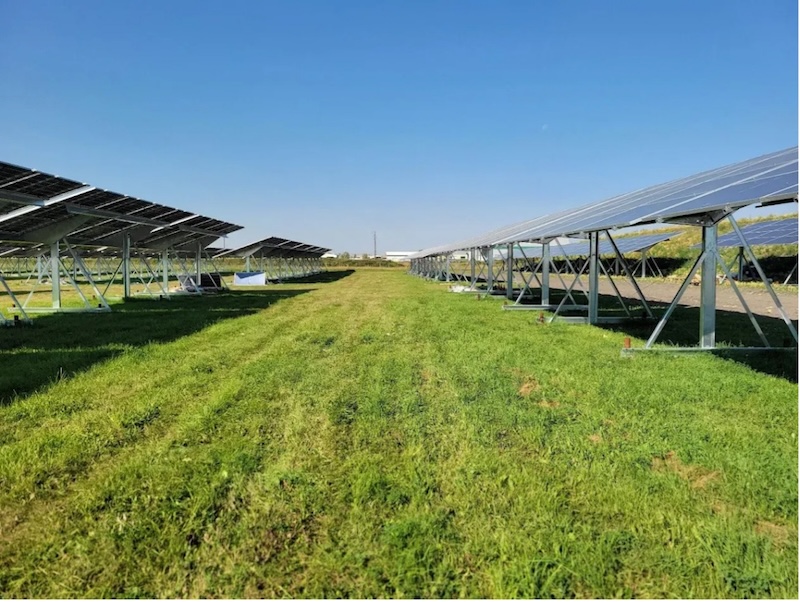
“The end game is how to optimize dual use of the land,” explains Dr. Semeton Amosu, a research associate and soil scientist with the Olds College Centre for Innovation, who’s been focusing on agrivoltaics.
“I just think we have such a good story,” said Patrick Gossage, Founding Director and President of Agrivoltaics Canada. “There’s benefit to the land itself, to the health of the soil, to water retention. We’ve proven that there’s a massive benefit to the farmer.”
Gossage describes Agrivoltaics Canada as a farmer-first ‘voice’ for agrivoltaics projects and research.
“Ultimately, what we’re looking to do as an organization is push government policy to create more ‘fertile ground’. I use that with the pun intended for agrivoltaics.”
While a wide variety of agricultural production is being done with agrivoltaics, lower-set ruminants like sheep and goats have often been the first choice for grazing options. But Gossage says cattle are high on the list.
“People refer to it as the Holy Grail of agrivoltaics. So it’s pretty damn big, and we’re seeing it work at scale in the U.S. My for-profit company, Good Energy Partners, has two cattle voltaic projects in the works, one in Alberta and one in Ontario. And we’ve been working with a group out of the U.S. called Huwa, who are operating hundreds of megawatts of cattle voltaic projects. So we’ve been leaning on them to help us with the design of cattle-friendly agrivoltaic systems. According to them, there is a much smaller requirement of additional capital expenditure than most people would think,” adds Gossage.
Amosu explains for cattle, it’s all about how panels are configured and spaced, as well as the height of the racking system. The global growth of the solar energy industry has greatly reduced the costs of the initial infrastructure, giving some wiggle room to accommodate cattle-friendly designs.
With more questions than answers yet about cattle and agrivoltaics, Amosu sees an urgent need for research. Olds College of Agriculture and Technology hosted Agrivoltaics Canada at a conference on the topic last June. The result showed the interest of many companies, but also the complexities—everything from policy, to insurance, to racking configuration. It ended with the decision to do more data gathering.
Bradley envisions projects with an Adaptive Multi-Paddock Grazing system using either high tensile electric fencing or ultimately, collared invisible fencing technology . . .
“We need to compare before and after. Once we have the data coming up, it will be easy to convince the stakeholders these things work. Nobody’s taking agricultural land away from you,” says Amosu.
“One of the ways I look at it is that it’s not an ‘either/or’ conversation,” adds Jason Bradley, CEO of SunCycle Farms. “It’s ‘both/and’.”
SunCycle is unique because its sole focus is on agrivoltaic design and operation. The firm has been contracted by an Italian based solar developer for several projects. That includes a cattle enterprise on 600 acres in Rich Valley, near Legal, which is in the design phase.
Bradley’s ramp to agrivoltaics comes from his own background, including past experience as manager of the Bar 75 Ranch on the Eastern Slopes.
“‘I’ve spent 20 years on the back of a horse, and I know both ends of the cow pretty well. So I’m coming at it from that perspective. I’m also coming at all of this from a regenerative agriculture perspective. How do we make the soil better? How do we grow higher nutrient dense food, and how do we make sure that everybody’s profitable, first and foremost in all of this?”
Bradley envisions projects with an Adaptive Multi-Paddock Grazing system using either high tensile electric fencing or ultimately, collared invisible fencing technology, to rotate the animals to different sections under the panels. A company called Nextpower already has the software capability for a rotational grazing approach.
He also points to Eric Steeves, implementing a similar grazing system with a rapidly growing sheep flock on his land, which is part of the 3,300-acre Travers Solar Project at Lomond, the largest solar farm in Canada. Along with the regular lease payments from the solar company, Steeves is paid for his vegetation management services.
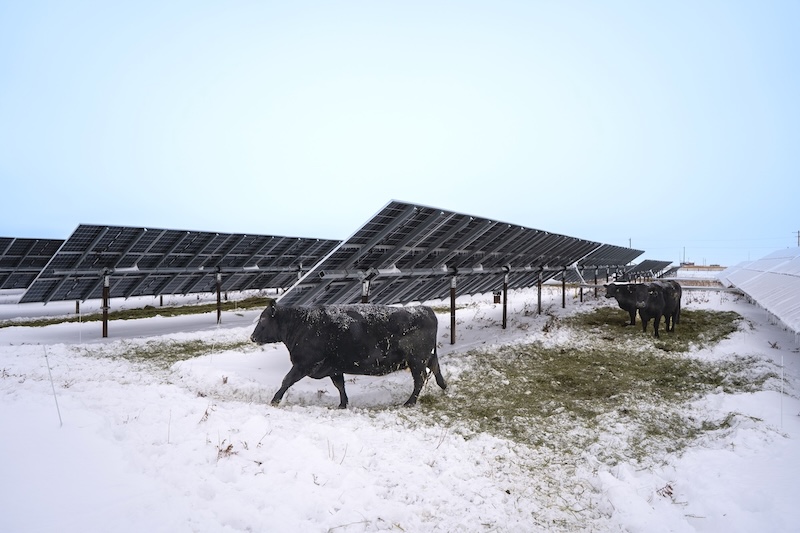
SunCycle has an agrivoltaics demonstration farm by the town of Cardston’s solar facility, to showcase related technologies. That included grazing nine bred cows around the panels, and Bradley says it didn’t take them long to figure out how to navigate the tighter spacing and rows for both regular and bale grazing.
Concerns about cattle damaging panels is an area of study the Olds College has proposed in a project with Azgard Solar, which makes racking systems. It would see a row of solar panels installed at the college’s feedlot.
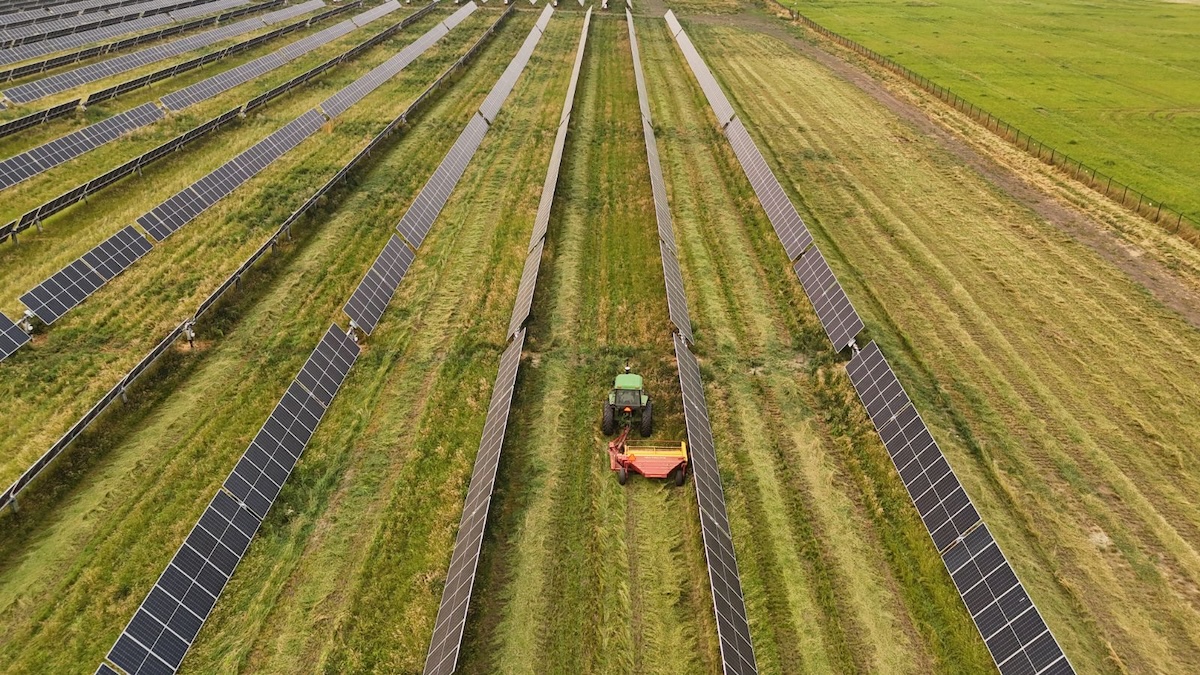
Other ongoing work looks at the viability of forages in agrivoltaics, with hay production already started at the Sollair Solar facility near Airdrie. Bradley and SunCycle hope to demonstrate increased forage production under panels with their research.
Another project just underway involving the Olds College and the University of Alberta is a survey on producer awareness of agrivoltaics, and perceived concerns. That will shape the research, keeping in step with the industry application focus of the OCCI.
There are some existing image challenges with landowners.
Amosu believes that goes back to shared use of agricultural land for oil and gas production, where decommissioning of wells has often been lacking.
Bradley acknowledges since there weren’t any early requirements for solar players to keep agriculture in place, lack of proper land management contributed to weed issues, and perceptions of solar projects as ‘land wasted’.
Both point out Alberta Utilities Commission Rule 007 will set the stage for better results from energy and agriculture on the same land. It requires an agricultural operation on any Class 2 land to achieve at least 80 per cent of former yield, in order to get AUC approval for an agrivoltaics project.
“We’ve seen lots of reports that cattle under are less stressed because they’ve got shade on high heat days, and they’re producing more milk.”
“You actually have to have a design that proves the operational capability of whatever crop you’re going to grow there. You have to show the business case and truly demonstrate an agriculture first approach,” explains Bradley. He also notes solar developers also have to put up a large reclamation bond for projects, which guarantees the money is there for cleanup, and is actually restricting some of the investment.
So what’s the future for cattle agrivoltaics in Alberta?
“I am one hundred per cent…maybe for the sake of emphasis…150 per cent convinced the potential is there,” smiles Amosu. “I have seen it work, and I know it can work here. I know what is slowing us down—the concerns and questions that haven’t been answered properly.”
What Amosu would like to see to advance the industry is the creation of a first-in-Canada Agrivoltaics Research and Learning Center at the Olds College.
“The average solar developer doesn’t want to experiment with their projects. The landowner is also unsure, wanting to know what crops can be grown, and not relying on experiences in the U.S. or other places.”
“The biggest thing is going to be education and demonstration,” confirms Bradley. “As farmers and ranchers, we all want to be first to be second. So we have to demonstrate the practices that we know already work, but in a live situation, so that producers can look at that and go, ‘Okay, I get it—it isn’t just a PowerPoint presentation. You’re actually showing it’.”
“Cattle voltaics at scale I believe is much closer than we think,” states Gossage. “I think that there’s just going to be a realization that this works. It helps the animal. We’ve seen lots of reports that cattle under are less stressed because they’ve got shade on high heat days, and they’re producing more milk. They’re yielding more protein. I think once this data starts reaching people and people see it with their own eyes, I think it’s going to happen really, really quickly.”
Photos supplied by interviewees.
This article was first published in Volume 6 Issue 1 of ABP Magazine (February 2026). Watch for more digital content from the magazine on ABP Daily.
Leave a Comment
Latest News
-
March 31, 2026 Checking in with ABP
Solar Grazing: Examining agrivoltaics in Alberta
-
March 31, 2026 Checking in with ABP
CCA: Statement on proposed federal livestock traceability regulations
-
March 30, 2026 Checking in with ABP
Canfax Weekly Article | Report for the week of March 30, 2026
Cattle Report
Updated: March 31, 2026
Steers
Live: ---
Rail: ---
Heifers
Live: ---
Rail: ---
Choice Steers
Live: ---
Rail: ---
Choice Heifers
Live: ---
Rail: ---
Boner Cows
Over 500 lbs: 321.30
Canadian Dollar
$71.98 0.06
Livestock Price Insurance Index
| Expiry | Fed | Feeder | Calf |
|---|---|---|---|
| 22-Jun-26 | 314 | 466 | -- |
| 20-Jul-26 | 308 | -- | -- |
| 17-Aug-26 | 304 | 466 | -- |
| 14-Sept-26 | 298 | 466 | -- |
| 12-Oct-26 | 294 | 466 | 580 |
| 09-Nov-26 | 284 | 456 | 572 |
| 07-Dec-26 | 288 | 448 | 574 |
Last Updated on March 26, 2026

Add abpdaily.com to your home screen
Tap the menu button next to the address bar or at the bottom of your browser.
Select ‘Install’ or ‘Add to Homescreen’ to stay connected.
Share this article on
About the Author
Dianne Finstad used her ranch roots to spur on what’s become a long communications career in television, radio and writing, covering agriculture and rodeo. She’s based in the Red Deer area. She serves on boards for Lakeland College and Westerner Park, and you can find her on RFD-TV Canada’s new show Frontline Farming Canada.