Live: ---
Rail: 490.00-495.00 del

{{ weatherTemp }}°C
{{ weatherCity }}

AB Direct - Steers
AB Direct - Heifers
Live: ---
Rail: 490.00-495.00 del
Rail: 490.00-495.00 del
US Trade- Steers
Live: 218.00 (IA)
Rail: 345.00 (IA)
Rail: 345.00 (IA)
US Trade - Heifers
Live: 218.00 (IA)
Rail: 345.00 (IA)
Rail: 345.00 (IA)
Canadian Dollar
$72.22
0.34
0.34
May 6, 2026
News
Canadian Beef Producers call on Federal Government to stand up for industry
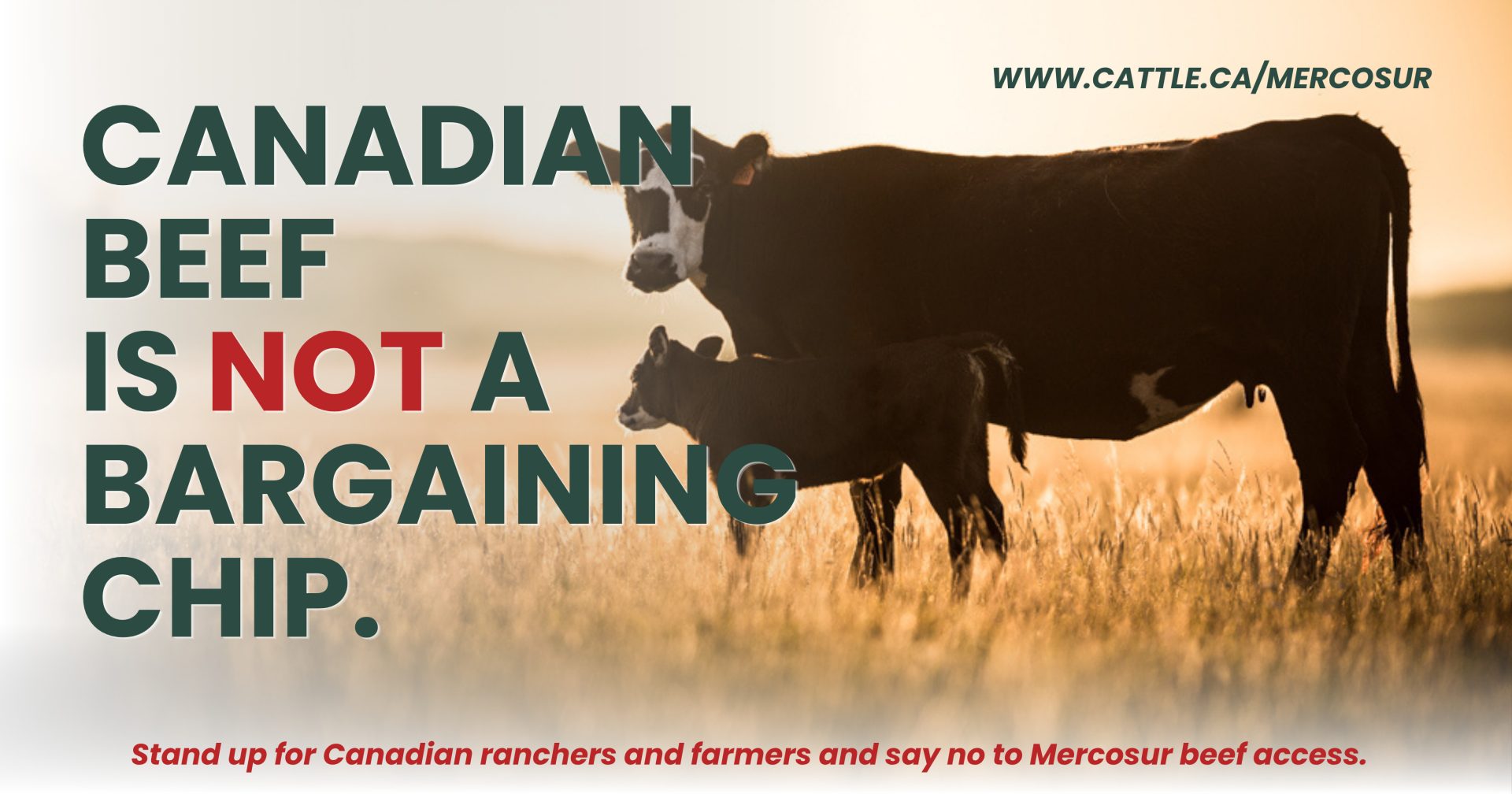
As Canada approaches the final round of Mercosur trade negotiations, Canada’s beef producers are sending a clear and united message to the federal government: do not sacrifice Canadian beef in a rushed trade deal.
The Canadian Cattle Association (CCA) and the National Cattle Feeders’ Association (NCFA), together representing all beef producers in Canada, strongly oppose the inclusion of beef market access in a potential Mercosur agreement. The organizations are calling on the Government of Canada to stand firmly with Canadian ranchers and cattle feeders and ensure Canadian beef is not used as a bargaining chip.
“Canadian beef producers support global trade that is science-based, transparent and reciprocal,” said Tyler Fulton, President of the Canadian Cattle Association. “Canada is already one of the most exposed beef markets in the world. Adding permanent, broad-based beef access for Mercosur countries would undermine our industry at a critical time and send the wrong signal to producers who are working to rebuild the national herd.”
Canada already relies on imports for approximately 30 per cent of domestic beef consumption, significantly higher than major competitors such as the United States, the European Union, or Australia. After years of drought, rising costs, and market disruptions, Canadian producers are only now beginning to see signs of recovery. Additional low-cost imports risk stalling herd rebuilding, reducing domestic supply, and increasing Canada’s reliance on imports—the exact opposite of what the Government of Canada is intending with increasing domestic food security.
Beyond economic exposure, beef producers have serious concerns about animal health and regulatory standards in parts of the Mercosur region.
“Protecting animal health is foundational to Canada’s beef industry and must remain an absolute priority,” said Brad Deleeuw, Chair of the National Cattle Feeders’ Association. “Including beef access from regions with a history of foot-and-mouth disease, questionable BSE reporting transparency, and inconsistent sanitary and phytosanitary compliance puts our national herd—and rural economies—at unacceptable risk. A foreign animal disease outbreak would be catastrophic.”
Canadian beef producers also caution that Mercosur beef does not compete on a level playing field. Lower production costs in the region are driven by weaker standards for animal health, labour, and environmental protection, undercutting Canadian farmers who meet some of the highest standards in the world. While supportive of trade diversification, CCA and NCFA emphasize that diversification must be strategic and reciprocal.
“Trade diversification only works if it expands export opportunities—not if it simply increases imports,” added Fulton. “Canada’s beef sector is highly integrated with North American supply chains, and our most important trading relationship is with the United States. On the eve of a critical CUSMA (Canada-United States-Mexico Agreement) renewal, rushing into a risky Mercosur deal creates unnecessary friction and threatens our most vital export market.”
Canada’s beef sector stands ready to work constructively with the federal government to expand exports and strengthen trade relationships. However, producers are clear: responsible trade policy must protect the health of the national herd, maintain high standards, and support long-term growth at home. “
The Canadian beef sector has the potential to help propel our economy forward,” said Deleeuw. “But that requires government to work beside us—not against us. We urge negotiators to say no to Mercosur beef access and to deliver trade outcomes that truly support Canadian farmers, ranchers, and rural communities.”
Canadian beef must not be a bargaining chip.
Share this article on



Latest News
-
September 4, 2026 News
Alberta moves to keep aging solar panels out of landfills
-
September 3, 2026 News
Nine Albertans named Canadian Cattle Young Leaders finalists
-
September 2, 2026 Business Tools
Do you own a pre-2002 confined feeding operation without a permit from the NRCB?
Cattle Report
Updated: September 4, 2026
Steers
Live: ---
Rail: 490.00-495.00 del
Heifers
Live: ---
Rail: 490.00-495.00 del
Choice Steers
Live: 218.00 (IA)
Rail: 345.00 (IA)
Choice Heifers
Live: 218.00 (IA)
Rail: 345.00 (IA)
Boner Cows
Over 500 lbs: 302.33
Canadian Dollar
$72.22 0.34
Livestock Price Insurance Index
| Expiry | Fed | Feeder | Calf |
|---|---|---|---|
| 30-Nov-26 | 266 | 424 | -- |
| 25-Jan-27 | 266 | 420 | -- |
| 22-Feb-27 | 264 | 410 | -- |
| 22-Mar-27 | 268 | 408 | -- |
| 19-Apr-27 | 274 | 406 | -- |
| 17-May-27 | 280 | 412 | -- |
| - | - | - | - |
Last Updated on September 3, 2026