Live: ---
Rail: 489.25-492.50 FOB feedlot (last week)

{{ weatherTemp }}°C
{{ weatherCity }}

AB Direct - Steers
AB Direct - Heifers
Live: ---
Rail: 489.25-492.50 FOB feedlot (last week)
Rail: 489.25-492.50 FOB feedlot (last week)
US Trade- Steers
Live: 222.00-224.00 (NE, IA) , 225.00-226.00 (TX, KS) last week
Rail: 350.00 (NE, IA) last week
Rail: 350.00 (NE, IA) last week
US Trade - Heifers
Live: 222.00-224.00 (NE, IA) , 225.00-226.00 (TX, KS) last week
Rail: 350.00 (NE, IA) last week
Rail: 350.00 (NE, IA) last week
Canadian Dollar
$71.82
0.31
0.31
May 29, 2026
Innovation & Technology
When artificial intelligence enters the feedyard
Dr. Luis Tedeschi provides insights on how precision nutrition and emerging tech could reshape ruminant systems
The future of ruminant nutrition will be driven by far more than feed formulation alone, according to Dr. Luis Tedeschi of Texas A&M University.
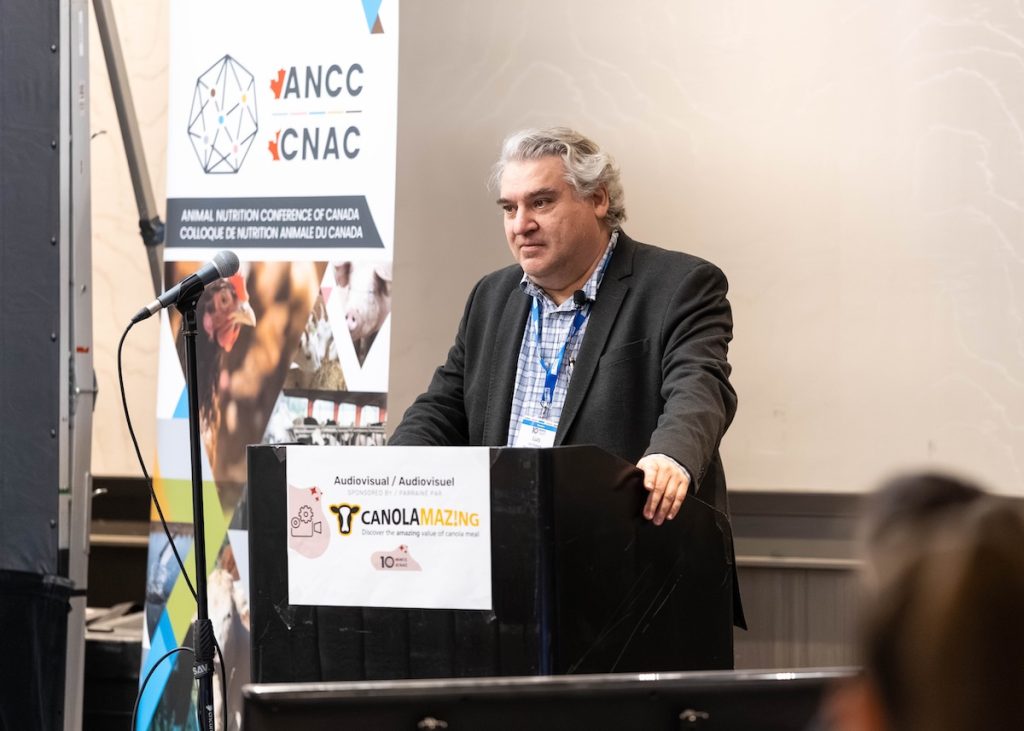
Speaking during the Ruminant Session at the 2026 Animal Nutrition Conference of Canada (ANCC), May 5-7 in Edmonton, Tedeschi outlined how artificial intelligence (AI), precision livestock farming and integrated crop-livestock systems are beginning to reshape the way producers think about cattle nutrition, sustainability and farm management.
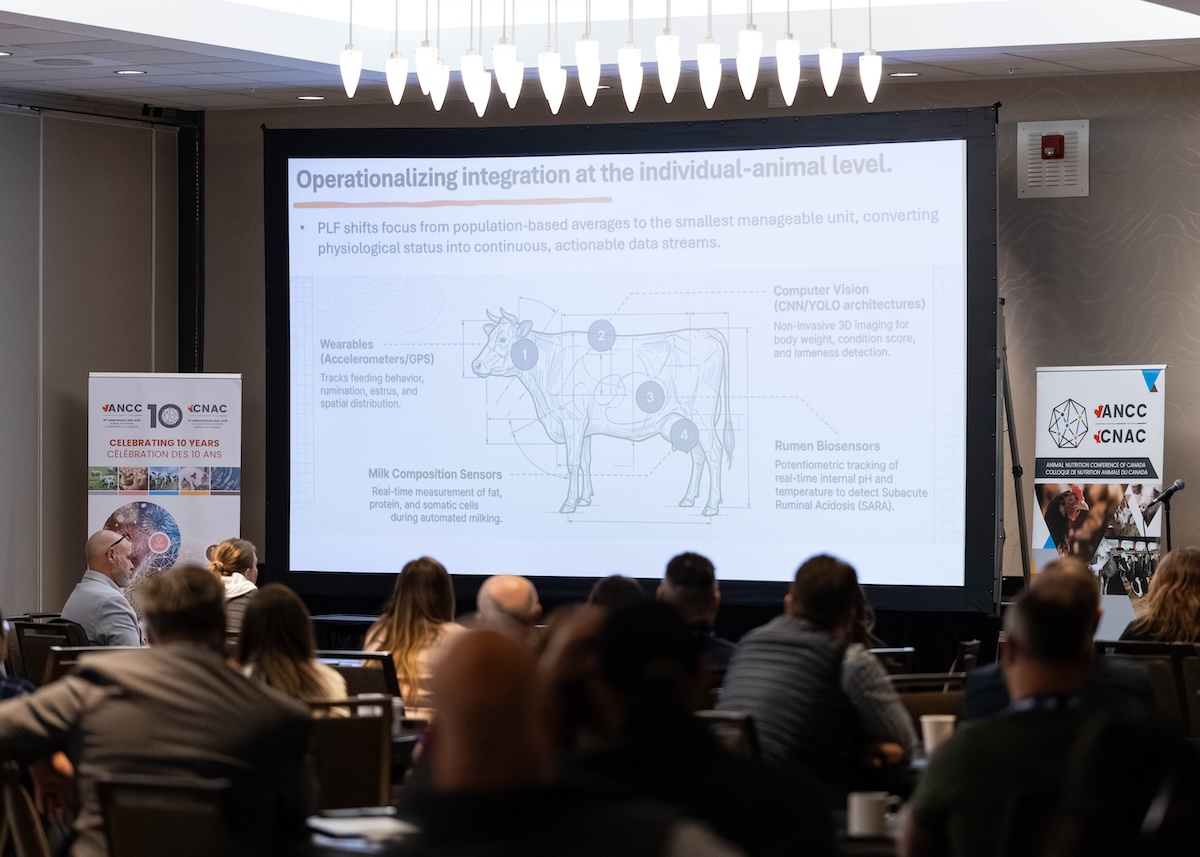
Tedeschi’s presentation, Nutrition as the Intelligent Nexus: Integrating Precision Farming into Sustainable Ruminant Systems, focused on how emerging technologies, including sensors, satellite imagery, AI machine learning and real-time monitoring systems, are enabling more responsive and individualized feeding strategies.
“The shift from average-based to precision-based feeding is one of the most consequential changes underway in ruminant production,” Tedeschi explained.
“Nutrition, in general, is much more than just feeding animals. It is the connecting point between soil, crops, animal health, farm efficiency, environmental stewardship and even the quality of food that reaches people.”
Throughout his presentation, Tedeschi advised the industry should increasingly shift toward data-driven approaches capable of adapting to biological complexity in real time.
“I think the industry should move from being reactive management to something more proactive,” said Tedeschi. “The opportunities are here.”
A major focus of the presentation was the growing role of Integrated Crop-Livestock Systems (ICLS), which reconnect crop production, grazing systems and nutrient cycling into a more coordinated farm ecosystem.
“When crop and livestock systems are viewed together rather than separately, feeding strategies become more efficient, more resilient and better connected to the long-term sustainability and profitability of the whole farm,” said Tedeschi.
Tedeschi described how technologies such as virtual fencing, GPS-enabled monitoring collars, drone imagery and satellite-based remote sensing are increasingly allowing producers to align stocking rates, forage availability and animal requirements with ecosystem carrying capacity.
He also outlined how AI-enabled systems can help producers identify issues earlier and make more precise management decisions.
“AI is beyond analyzing data,” said Tedeschi. “It’s about asking questions.”
One example involved computer vision systems capable of identifying subtle behavioural changes in cattle that may indicate health challenges long before they become visible to producers or feedlot staff.
“For example, a computer vision can actually tag that animal and tell you that animal might have a higher probability of having liver abscess,” Tedeschi explained.
While optimistic about the potential, he urged a measured and practical approach to adoption.
“I would not recommend anybody implement everything right away,” he said during the question period following his presentation. “There are cost factors and this is something to phase in over time based on the needs and opportunity of each operation. As a starting point, I would suggest using the sensors to collect the data to find relationships with those variables that you can collect on a daily basis.”
Tedeschi repeatedly returned to the idea that nutrition should no longer be viewed simply as an input for production, but rather as a systems-level tool connecting soil health, crops, animal performance, environmental stewardship and human nutrition.
“Don’t be afraid,” Tedeschi advised while discussing AI adoption in agriculture. “Embrace it. It’s a tool.”
Share this article on