Live: ---
Rail: 495.00-500.00 del

{{ weatherTemp }}°C
{{ weatherCity }}

AB Direct - Steers
AB Direct - Heifers
Live: ---
Rail: 495.00-500.00 del
Rail: 495.00-500.00 del
US Trade- Steers
Live: 218.00 (IA, NE)
Rail: 345.00 (NE, IA)
Rail: 345.00 (NE, IA)
US Trade - Heifers
Live: 218.00 (IA, NE)
Rail: 345.00 (NE, IA)
Rail: 345.00 (NE, IA)
Canadian Dollar
$70.27
0.26
0.26
June 25, 2026
Checking in with ABP
Farm Real Estate Values: What Sellers, Buyers and Families Need to Know
It is no secret that farmland is worth more than ever before. With so much on the line for producers making decisions about land, it is more important than ever to understand what influences farm real estate values.
Status of the farm real estate market
“The farmland market has been hot for a good 10 years now,” says Rees Smith, a realtor with the Smith & Griffith real estate team of CIR Realty. “Farm Credit Canada comes out with farmland value trends annually. The latest 2025 stats show that Canada-wide, the national trend is a 9.3 per cent appreciation on farmland. Alberta is leading the way with 11.4 per cent appreciation in 2025, which is above the five-year average.”
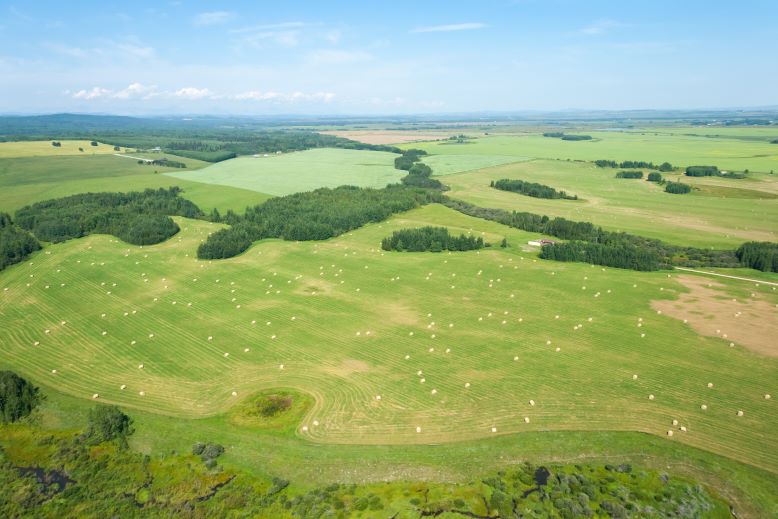
Most of the rise in farm real estate is coming from cropland. “We’ve seen an average in that $8,000 to 10,000 per acre range to as high as $13,000 an acre,” says Smith. “Pastureland appreciated at a slower rate of 3.8 per cent last year, with your traditional rougher bush pasture type lands that aren’t cultivatable per se averaging around $5,000 an acre.”
Generally, farm real estate is reflective of the markets for the commodities grown on that land. The strong cattle market is driving higher pasture values, but recent downturns in crop prices have not decreased cultivated land prices. “We’ve seen a major increase in corporate-type farming,” says Chase Westersund, vice-president of LandQuest Realty Corporation. “So, it’s kind of kept cropland in line with the inflationary pressures we’ve seen on ranch-style lands.”
Factors like geopolitical conflict, fuel and fertilizer costs, and government policies do temper rising values.
“It is a strong market, but a price-sensitive market,” says Westersund. “Ranch operations need the asking price to be justifiable in terms of productivity.”
As Smith explains, strong cattle prices will not drive pasture and hayland to the same value as cultivated land, but producers can expect to see the rate of appreciation for cattle-suited properties creep closer to that of cropland.
Despite inflation driving higher input costs that tighten margins, producers are motivated by the scarcity of land and the need to capitalize upon purchase opportunities in their area, leading land values to grow with inflation too. “The old adage is that they don’t make any more of it,” says Smith.
Determining property values
Researching comparable sales in the area is the most common method for appraising farm real estate.
Westersund explains that a ranch property is “broken down into its various land components, with a price per acre applied using comparable sales and extrapolating those to the subject ranch.”
Comparable sale values can be found through MLS realtors, online auctions, or private sale data from land titles. Both Smith and Westersund note that local producers can be a source of land sale information, but that local gossip is frequently inaccurate and needs to be verified.
Like any real estate, where the property is situated plays a large role in how farmland is priced. Smith identifies accessibility and quality of access roads, landlocked geography, and proximity to urban centres as key considerations.
Topography, soil quality, and productivity also come into play. “You look at the highest and best use of that land,” says Smith. He uses the Canadian Land Inventory to get a general idea of soil quality and seeks out crop production specialists and producers in the area who may have knowledge of local soil testing.
“As a rule of thumb, pasture is usually 50 to 60 per cent of the value of cultivated acres,” says Ty Wilson, a purebred Angus breeder and realtor at Alberta Realty Inc. “For marginal land, like trees and water, it’s sometimes only 25 per cent of the value of cultivated acres.”
If the current owner of the property or the region can supply good quality data about the productivity of the ranch property, land prices can also be evaluated by animal unit months. “You figure out the number of animal units that a ranch can sustain, and then you apply a value figure to that specific AUM capacity of that ranch,” says Westersund.
Another factor that influences property values is the presence of revenue opportunities on the land, such as oil and gas surface leases, mineral rights, or gravel pits. “Sometimes I’ve seen multipliers of three to five times the value of the annual surface lease, even as high as 10 times the surface lease value,” says Smith.
Conversely, surface leases that disrupt the utility of the property for agriculture can decrease the value of the property, such as a pipeline that blocks a prime potential yard site. “Other types of caveats, whether they be conservation easements, right-of-ways, entry points for subservient quarters to allow access, those things do affect value,” says Smith. “It’s a downward price influence, depending on how restrictive the details of that instrument are.”
If a parcel has already been subdivided with the residential acreage or farmstead taken out, that also reduces value. “It is like a coupon that is clipped out of the quarter, rendering the remainder of the quarter at a lesser value than if that opportunity remained,” Smith says.
Infrastructure can also add to the value of farm real estate. Cattle handling facilities, shops, residences, and other buildings can all add to the value of a property. “The house value is going to be variable depending on the prospective buyer,” says Westersund. “Just because you’ve built an expensive house on your property doesn’t necessarily increase the value of the operation in the eyes of certain types of buyers. The statement we hear is that a nice house has never put a pound on a calf.”
Considerations for buyers and sellers
Given that the price of farm real estate is so closely tied to production, it’s no surprise that sales tend to follow the pattern of a growing season. “The most activity we experience is from Christmas through till June,” says Westersund. “Buyers are out looking before things green up because they need to prepare themselves in terms of purchasing inputs or expanding their herd.”
Marketing farm real estate from a seller’s perspective has changed over the years with digital channels. Realtors can now help sellers advertise their property outside of the local area, capturing urban investors and individuals looking to expand or relocate their operations in different regions.
Choosing a realtor that understands farms and how to portray them is key, says Westersund. Smith explains that the ideal time to take footage of a property is in the summer when land looks lush and productive. “Make sure your land and fences are in good shape,” he says. He also recommends pulling together as much information about your property as possible, including tax notices, water well reports, surface lease revenue stubs, any production data, and average rainfall.
When it comes to marketing, sellers now have the option to choose an auction sale instead of a traditional MLS listing. Auctions capitalize upon opportunistic buyers with a deadline, explains Smith. As a result, auctions can often fetch higher prices.
“Auctions work well for things like quarter sections of grain land, where several operators in that area can seamlessly integrate that parcel,” says Westersund. “It doesn’t work as well for cattle ranches, because they are so variable. They require facilitation and pairing the right buyer.” Wilson also notes that selling through auction comes with higher commissions.
On the buyer side, Westersund notes that the biggest limitation is money.
“Find a lender that understands land and farming and ranching as a business,” he says. “For a lot of the major banking institutions, it’s beyond their scope of expertise, and either they won’t touch it, they’ll charge you an absurd interest rate, or they will only loan you a fragment of what’s required.”
While a good deal on a piece of land can seem enticing, Wilson cautions that cheap land is often cheap for a reason. “There was a time when you could sell a quarter and move to another province and get three quarters,” he says. “But in many cases, those three quarters only produced what that one quarter did that you sold. I would be leery of when a deal’s too good to be true.”
Westersund echoes this sentiment, encouraging buyers and sellers alike to focus on their business. “Don’t rush the due diligence,” he says. “Eliminating emotion as much as possible from the purchase or selling decision is going to result in a better outcome.”
Looking ahead
Many farm families are currently in the process of transitioning the farm to the next generation, and farm real estate is a key part of that process. All three agents agree that understanding the value of the assets you possess is key so that you can allocate them in a way your family feels is fair.
Keeping a pulse on the real estate market is wise, says Wilson. While a formal appraisal is useful, Westersund explains that it is not necessary to pay for one each year. Instead, watching for annual values from sources like Farm Credit Canada and the Alberta government can help maintain an estimate of real estate value in between formal appraisals around major life events.
Wilson’s advice for families going through succession is to “treat the family farm like what it is, the greatest asset you have.” Young farmers like himself that purchase their own land often feel free to be more aggressive in leveraging their land assets to expand the operation.
“If I’m dealing with the farm that’s been in my family for generations, I might not have the gumption to lay it on the line of security in case things went bad,” he says.
Looking into the future, Westersund sees economies of scale continuing to dominate the land market. Rising input costs are threatening smaller farms, enabling the consolidation of farmland by larger corporations and farms.
Smith also sees farm real estate prices continuing to rise into the future. With that in mind, he thinks of his dad’s advice: “You always buy land that comes available on your fence line.” While a land purchase still needs to make good business sense, rented land bears risks of unpredictability and does not build equity.
Across the board, these realtors identify Alberta as part of Canada’s breadbasket and encourage producers in the province to keep investing in the future of the industry, through real estate and otherwise.
This was first published in Volume 6 Issue 2 of ABP Magazine (June 2026). Watch for more digital content from the magazine on ABP Daily
Share this article on



Latest News
-
October 9, 2026 Current Markets & Forecasts
USDA lowers beef production forecasts as feed grain supplies grow
-
October 9, 2026 Checking in with ABP
Giving thanks to the people behind our food
-
October 9, 2026 News
Nuffield Canada names four new scholars for 2027
Cattle Report
Updated: October 9, 2026
Steers
Live: ---
Rail: 495.00-500.00 del
Heifers
Live: ---
Rail: 495.00-500.00 del
Choice Steers
Live: 218.00 (IA, NE)
Rail: 345.00 (NE, IA)
Choice Heifers
Live: 218.00 (IA, NE)
Rail: 345.00 (NE, IA)
Boner Cows
Over 500 lbs: 268.04
Canadian Dollar
$70.27 0.26
Livestock Price Insurance Index
| Expiry | Fed | Feeder | Calf |
|---|---|---|---|
| 04-Jan-27 | -- | -- | -- |
| 01-Feb-27 | 288 | 456 | -- |
| 01-Mar-27 | 286 | 450 | -- |
| 29-Mar-27 | 290 | 448 | -- |
| 26-Apr-27 | 296 | 444 | -- |
| 24-May-27 | 304 | 450 | -- |
| 21-Jun-27 | 302 | 454 | -- |
Last Updated on October 8, 2026