Live: ---
Rail: 550.00 del

{{ weatherTemp }}°C
{{ weatherCity }}

AB Direct - Steers
AB Direct - Heifers
Live: ---
Rail: 550.00 del
Rail: 550.00 del
US Trade- Steers
Live: 244.00-246.00*few (KN, TX)
Rail: ---
Rail: ---
US Trade - Heifers
Live: 244.00-246.00*few (KN, TX)
Rail: ---
Rail: ---
Canadian Dollar
$72.62
0.06
0.06
(Beef Cattle Research Council)
January 16, 2026
Health & Production
Cracking the heritability code
Choosing traits that pay off
Improving the genetics of your beef herd starts with knowing which traits you can change through genetics and which traits respond better to management practices.
Because cattle have a long generation interval, every bull or replacement heifer you choose affects your herd for years.
Source: Beef Cattle Research Council (BCRC)
That’s why understanding heritability, and how traits interact with each other, helps ensure your breeding decisions move your herd toward your production goals.
What Heritability Really Means
Heritability tells us how much of a trait is controlled by genetics versus the environment and/or management. It’s expressed as a number between zero and one.
- High heritability (over 0.40). Traits are strongly influenced by genetics, meaning you can make changes more quickly by selecting the right replacements and bulls. Examples: ribeye area, marbling, weight and growth traits.
- Moderate heritability (0.15 to 0.40). Traits that can be improved through both genetics and management. Examples: milk production and calving ease.
- Low heritability (less than 0.15). Traits are mainly influenced by crossbreeding (e.g., heterosis/hybrid vigour) and management (e.g., nutrition, colostrum, vaccination). Examples: fertility, reproductive efficiency and disease resistance.
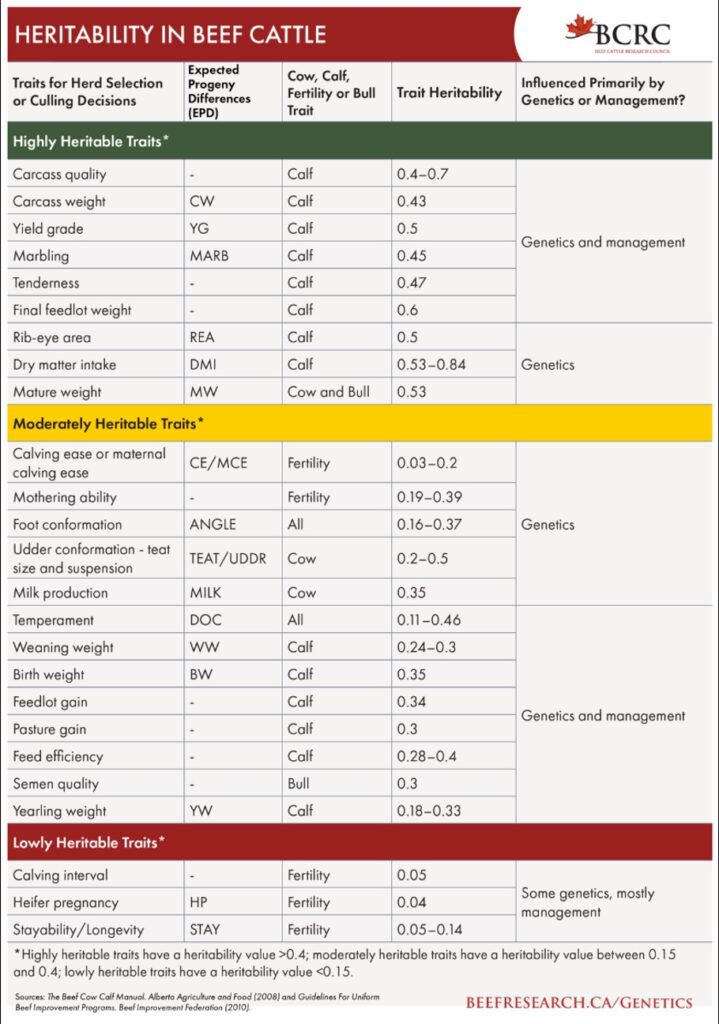
Weaning weight has a heritability of 0.24 to 0.30, which means that 24% to 30% of the differences we see in weaning weights between cattle in a herd are caused by genetics. The following table provides a summary of the heritability of common traits. The higher the heritability, the more progress you’ll make through selection. Traits with low heritability still matter — they just require dedicated management to go along with genetic decisions.
As an example, improving pregnancy rates in beef cattle cannot be achieved through genetics alone. This is primarily due to fertility traits having low heritability and being heavily influenced by management factors such as nutrition, body condition, health and breeding season management. Until those areas are optimized, selecting new genetics alone won’t move the needle.
In contrast, calving ease is moderately heritable, and information can be used strategically when planning a heifer breeding program. Selecting sires with high calving-ease genetics can help avoid calving difficulties.
Share this article on



Latest News
-
April 10, 2026 Checking in with ABP
Canadian Cattle Association encourages producer action in Mercosur campaign
-
April 10, 2026 Checking in with ABP
StatsCan: Cattle prices drive farm cash receipts
-
April 8, 2026 Checking in with ABP
Young Creators Contest winners celebrated
Cattle Report
Updated: April 10, 2026
Steers
Live: ---
Rail: 550.00 del
Heifers
Live: ---
Rail: 550.00 del
Choice Steers
Live: 244.00-246.00*few (KN, TX)
Rail: ---
Choice Heifers
Live: 244.00-246.00*few (KN, TX)
Rail: ---
Boner Cows
Over 500 lbs: 326.07
Canadian Dollar
$72.62 0.06
Livestock Price Insurance Index
| Expiry | Fed | Feeder | Calf |
|---|---|---|---|
| 06-July-26 | 326 | -- | -- |
| 03-Aug-26 | 322 | -- | -- |
| 31-Aug-26 | 314 | 482 | -- |
| 28-Sept-26 | 310 | 482 | 596 |
| 26-Oct-26 | 302 | 476 | 594 |
| 23-Nov-26 | 296 | 468 | 590 |
| 21-Dec-26 | 298 | 462 | 592 |
Last Updated on April 9, 2026