Live: ---
Rail: ---

{{ weatherTemp }}°C
{{ weatherCity }}

AB Direct - Steers
AB Direct - Heifers
Live: ---
Rail: ---
Rail: ---
US Trade- Steers
Live: ---
Rail: ---
Rail: ---
US Trade - Heifers
Live: ---
Rail: ---
Rail: ---
Canadian Dollar
$71.98
0.06
0.06
February 18, 2026
Business Tools
Extend the grazing season using stockpiled forage
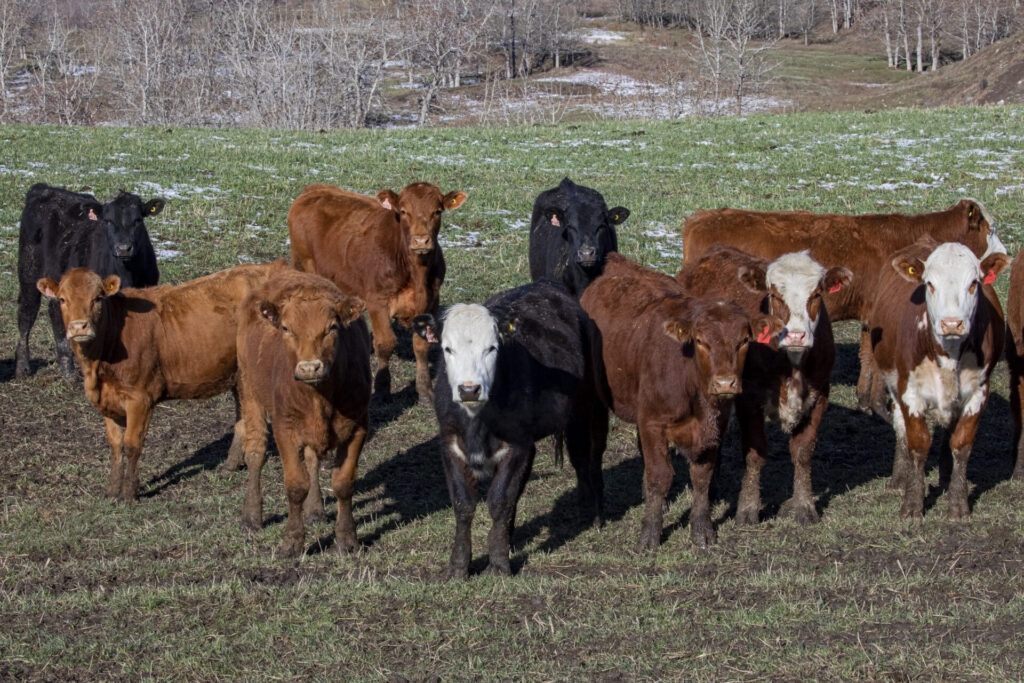
Grazing early in the season (April and May) reduces reliance on stored feed and allows beef producers to make the most of stockpiled perennial forage resources. According to the 2025 Canadian Cow-Calf Adoption Rates and Performance Levels Report, up to 61 per cent of Canadian producers winter cattle in pastures for all or part of the winter. For those producers not using confined feeding during this time, early-season grazing provides a transition from winter grazing or feeding to spring and summer grazing.
Early-season grazing isn’t about moving from pen to pasture, it’s about strategically managing cool-season grasses to balance nutrition, regrowth potential and pasture longevity. With the right timing, species selection and rest strategies, producers can take advantage of stockpiled forage and cool-season tame grasses to start off the grazing season before warm-season or native forages are ready.
“Every bale of hay we don’t feed is money we keep in our pocket,” says Brian Harper.
Harper manages a cow-calf and yearling operation near Brandon, Manitoba. Besides the feed cost savings, “our cows are healthier, they’re on pasture year-round, and we haven’t had any feet or digestive issues,” he says. “The exercise and consistent high-quality nutrition really pay off.”
Leah Rodvang, a cow-calf producer from east central Alberta, agrees about the economic and animal health benefits, adding, “Early-season grazing is an important management tool during May calving to reduce the risk of scours in newborn calves.”
When timed right, early-season grazing can:
- Extend the grazing season
- Reduce feed costs
- Maintain or improve pasture productivity
- Provide two grazing periods in one season
- Support calving management systems
Where and When To Include Early-Season Grazing
Rest periods are critical when grazing in the early spring. Because plants initiate growth during this period, grazing plans need to include adequate rest to allow for plant recovery and regrowth. Providing sufficient rest increases both above and below ground plant biomass, carbohydrates and growth rates when compared to plants grazed without a recovery period. Brian follows a rule of leaving 20 per cent of his acres ungrazed each season to rest completely and begins grazing on this stockpiled forage the next spring. “Stockpiled forage is essential,” Brian says. For him, planning in advance and moving daily has supported grazing from when the snow melts until the snow is too deep to dig through.
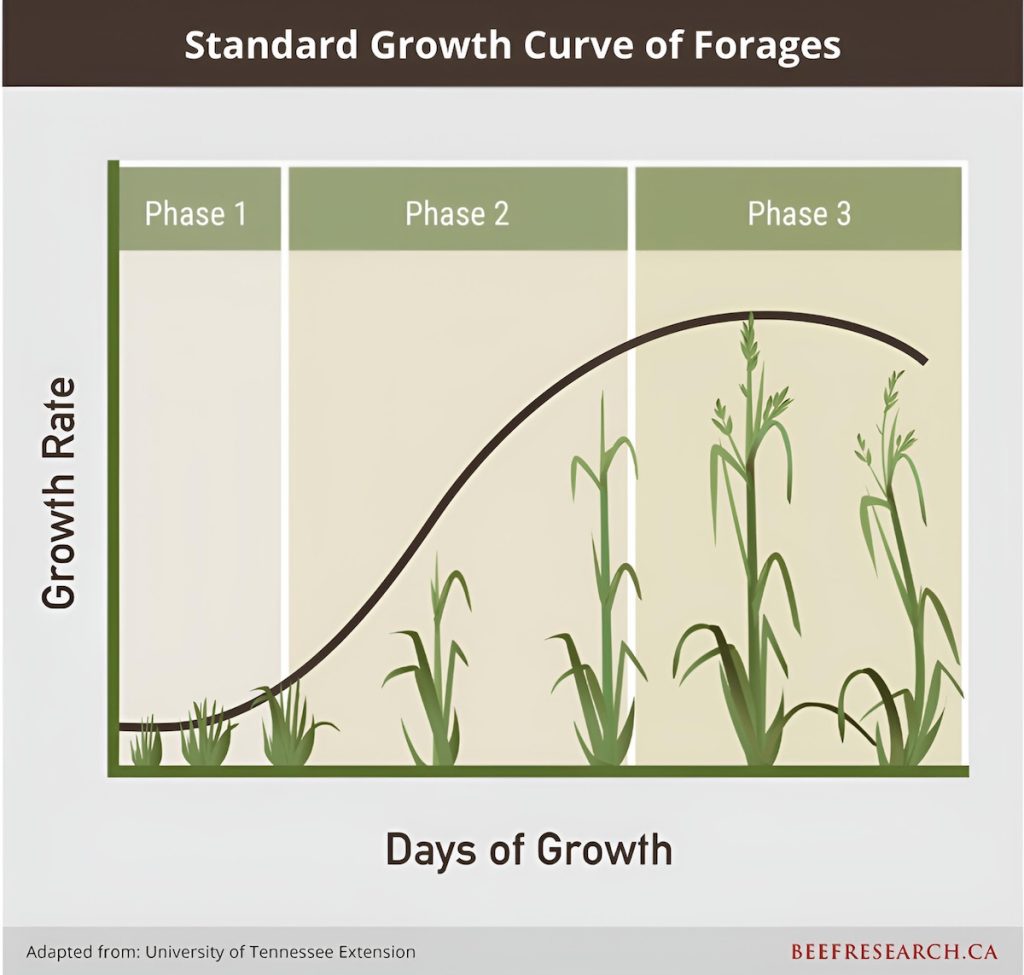
During early-season grazing, cattle remove critical leaf matter during Phase 1 of plant growth, when plants are especially vulnerable (Figure 1). At this point, the plant is relying heavily on root resources for growth and removing leaves during grazing reduces the leaf area available for photosynthesis. Managing grazing for lower plant utilization leaves more leaf area to photosynthesize and puts less stress on the plant roots. Extended rest periods provide additional time for the plants to both grow above ground and return nutrients to the roots. Without rest, desirable grazing plants lose their competitive advantage, leading to encroachment of undesirable or invader plant species.
Standard growth curve of forages
Producers can utilize a skim grazing strategy, moving cattle through the pasture system at a very rapid rate with a utilization rate lower than 50 per cent.
This allows for only the very tips of the leaves to be defoliated and enables the plant to continue photosynthesis with the remaining part of the leaf. The rate producers will have to move from pasture to pasture will depend on the size of their pastures and herd, varying from a few hours to a few days. “During early-season grazing, we rely on stockpiled forages from previous seasons. However, once the grass starts growing, we want to manage carefully to ensure that the grasses have enough leaf to continue photosynthesizing,” Leah says. “Estimating a 50 per cent forage utilization is a comfortable management strategy for us.”
Brian also relies on stockpiled forage for early-season grazing. However, his grazing system looks different. Grazing acres are split into thirds: the grazing season acres, the buffer zone and stockpile. “We graze as much as 80% but we balance that off with a longer rest period. Rainfall and timing of grazing impact the length of the rest period.” During the growing season, the grazing season acres are grazed multiple times. If the grazing season acres are not sufficient, cattle move to the buffer zone acres to allow rest and recovery before returning to the grazing season acres when plants are in Phase 2 (Figure 1). The stockpile section is given a full season of rest and used for early spring grazing, before and during spring growth.
Learn more about how to plan for early-season grazing in today’s post on BeefResearch.ca.
Share this article on



Latest News
-
March 31, 2026 Checking in with ABP
Strychnine emergency use approved for Alberta and Saskatchewan producers
-
March 31, 2026 Checking in with ABP
Solar Grazing: Examining agrivoltaics in Alberta
-
March 31, 2026 Checking in with ABP
CCA: Statement on proposed federal livestock traceability regulations
Cattle Report
Updated: March 31, 2026
Steers
Live: ---
Rail: ---
Heifers
Live: ---
Rail: ---
Choice Steers
Live: ---
Rail: ---
Choice Heifers
Live: ---
Rail: ---
Boner Cows
Over 500 lbs: 321.30
Canadian Dollar
$71.98 0.06
Livestock Price Insurance Index
| Expiry | Fed | Feeder | Calf |
|---|---|---|---|
| 22-Jun-26 | 314 | 466 | -- |
| 20-Jul-26 | 308 | -- | -- |
| 17-Aug-26 | 304 | 466 | -- |
| 14-Sept-26 | 298 | 466 | -- |
| 12-Oct-26 | 294 | 466 | 580 |
| 09-Nov-26 | 284 | 456 | 572 |
| 07-Dec-26 | 288 | 448 | 574 |
Last Updated on March 26, 2026