Live: ---
Rail: 490.00-500.00 del

{{ weatherTemp }}°C
{{ weatherCity }}

AB Direct - Steers
AB Direct - Heifers
Live: ---
Rail: 490.00-500.00 del
Rail: 490.00-500.00 del
US Trade- Steers
Live: ---
Rail: ---
Rail: ---
US Trade - Heifers
Live: ---
Rail: ---
Rail: ---
Canadian Dollar
$71.65
0.08
0.08
June 23, 2026
Business Tools
The Evolution of Lidobands
(Lidocaine Impregnated Bands)
An article appeared in ABP Magazine in December 2023 (view here) explaining the science behind Lidoband castration devices. They are now available in Canada in different sizes for different weights of cattle to be used with the appropriate banners.
They qualify as a compounded product because of the lidocaine impregnation, so in Canada they must be marketed through the veterinarians under a prescription. If you have an established veterinary-client-patient relationship (VCPR), it will not be a problem attaining them. I want to state that until recently I was a veterinarian working in the production animal field, and in my view, Lidobands are a significant improvement in animal welfare for a necessary practice in cattle production. I feel compelled to get the word out and your herd veterinarian can take it the rest of the way with you.
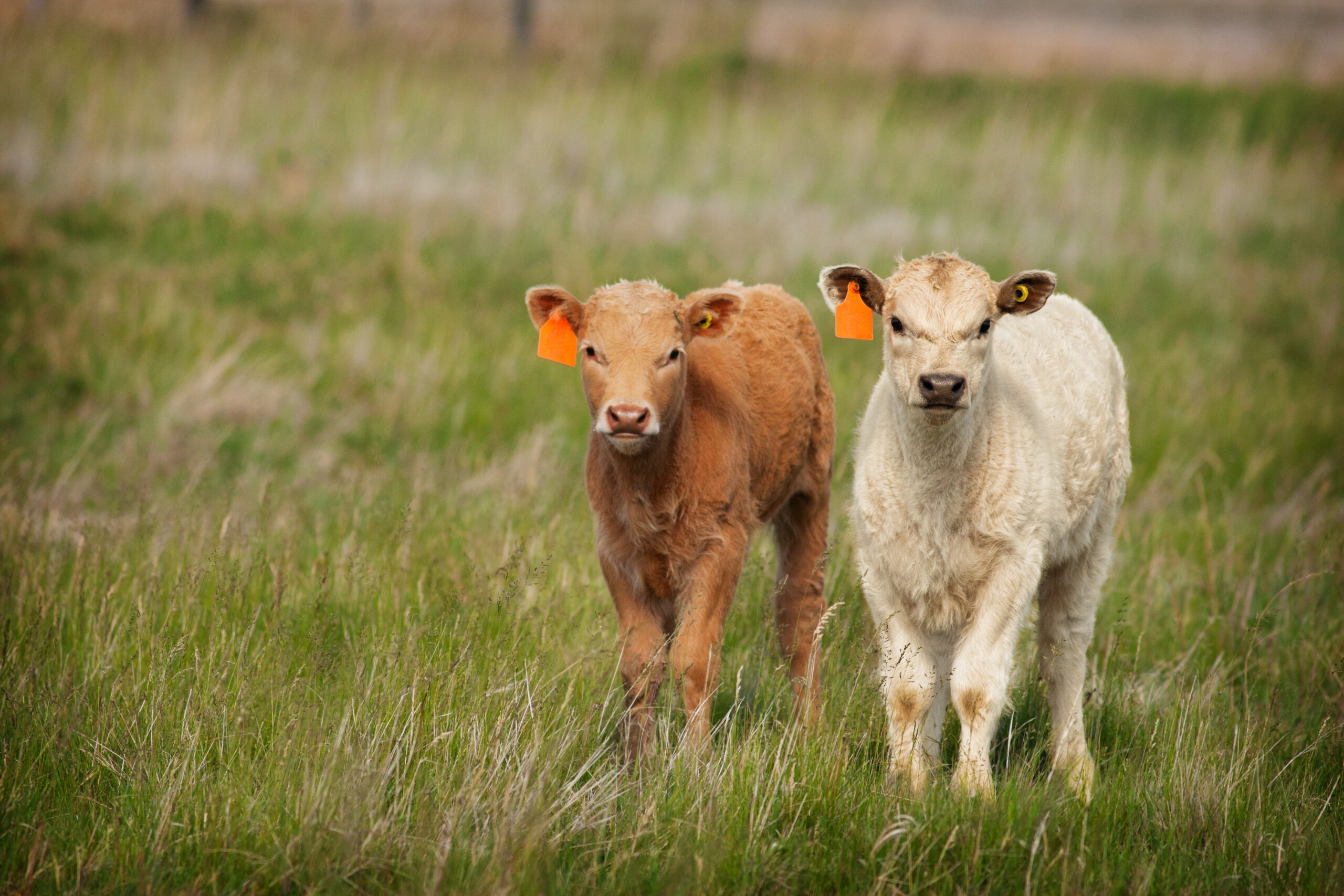
Castration bands for young calves have been used for a long time. Over time, large banders became popular for larger bull calves. The advantage was the absence of deaths from blood loss, and feedlot workers and ranch hands could be trained in their usage and perform the task very well. There are many calves castrated at processing or branding time. The last Beef Code of Practice was released in 2013 and provided guidance on the maximum age that required analgesics or NSAIDs of some sort. This, to me, started the age of using NSAIDs for painful conditions such as lameness, as well as painful procedures performed in cattle practice such as castration, branding and dehorning, all of which are very painful. It was cattle producers themselves that saw the huge benefits of NSAIDs on recovery performance and reduced secondary disease due to lower stress and pain. Veterinarians who still performed knife castrations would block the cord with lidocaine and/or use what we call a Rompun epidural, along with giving an NSAID.
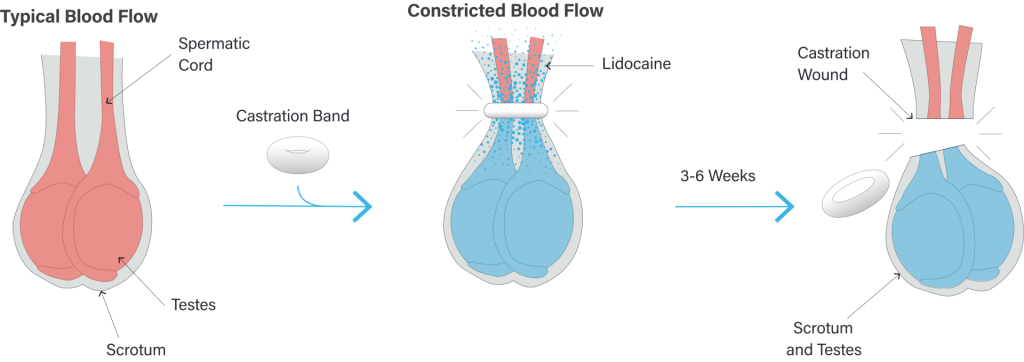
The Lidobands, available in a range of sizes, remove a lot of these hardships. A lidocaine block wears off within hours, but the ingenious feature of Lidobands is the slow release of lidocaine throughout the entire period until the scrotum falls off with the band. In early trials with the large Callicrate bands, studies found a real jump in inflammation and stress just as the scrotum was falling off so pain control right up until this time is a great idea. In comparison, NSAIDs typically only last about three days. The Lidobands provide local anesthetic protection starting at two hours and lasting up to 42 days post-application. In larger bulls, the scrotums fall off at about 30 days and in smaller bull calves much sooner than that, so basically the anesthetic effect of Lidobands lasts from beginning to end—a remarkable feat.
Proposed changes to the new Beef Code of Practice, currently in the public comment period, recommend castrating calves as young as possible and using pain control. This could be either NSAIDs or lidocaine. As an aside, the public comment period for the full beef code of practice runs from April 13, 2026, for two months. I would encourage producers to read it and reach out with comments. The very recent update was developed by an excellent committee and are intended to improve animal welfare practices over the next 10 years. I am satisfied that the proposed changes to castration move the bar forward, and in many ways, Lidobands will help us easily accomplish that.
With the slow-release technology of lidocaine, Solvet Laboratories in Calgary have developed four bands of increasing size designed for progressively heavier bull calves, with increasing amounts of lidocaine in larger bands. The bigger the band, the more lidocaine.
For more information, check out Lidoband.com. All the bands are compatible with banders already on the market.
Burdizzo castration has mainly become a technique of the past. Those that use the knife or scalpel to castrate must still administer NSAIDs. In the U.S., where Lidobands have been available for longer, uptake is growing steadily. There are many instances where Lidobands have replaced NSAIDs especially if other painful procedures are not done at the same time. The slaughter withdrawal period is five days after the band and scrotum have fallen off. It is best not to castrate if other stressful events are occurring such as weaning and transportation—instead, wait for the right time.
Use the bands according to the instructions and make sure both testicles have descended and are below the band. The instructional animated video at Lidoband.com is worth a look and explains correct application technique, which includes how to apply the band without touching them and wearing gloves. Retained testicles, or belly nuts, are still a problem in Canadian feedlots so we must be careful that bands are placed correctly and capture both testicles. Banding larger bulls can lead to tetanus so producers should discuss tetanus protection with their veterinarian before banding.
Tetanus is included in some multivalent clostridial vaccines such as Covexin Plus and Tasvax. I have seen deaths in large bulls following banding. It should be crystal clear that the use of Lidobands does not change potential susceptibility to tetanus. For newborn calves using the smallest Lidobands, tetanus protection is not necessary. Colostral protection should be adequate and the scrotum falls off quickly. I have never seen or heard of any tetanus problems when banding young calves in the first month of age.
The bands are impregnated with powdered lidocaine under pressure and then sealed so drying and degradation don’t happen. If properly sealed, the bands can be used the following season. The Australian animal welfare directory mandates banding of young calves using Lidobands, and in Australia, the small bands are also approved for sheep for both castration and tail docking. They are becoming adopted worldwide, but the beauty is they are manufactured in Canada, which ensures we have a reliable supply.
Transitioning from the old bands to the new Lidobands has been seamless. For those transitioning from other forms of castration, good information and data are available. Studies show an increase in gain of a few pounds, and a three-to-one return on investment. It is simply an easier way to castrate, easily teachable, and absolutely deals with any perceived animal welfare concerns with castration. The studies do not fully capture the improved health parameters, but castration is necessary, and Lidobands will become the new norm, in my opinion.
Every time I talk about castration and the calves are caught, it is also an ideal time to implant. You are simply replacing some of the hormones lost with the removal of the testicles. Different implants are available, including a few calf implants on the market. Again, talk to your veterinarian. It takes some practice to get good at implanting, but the return on investment—approaching 25-to-1, or even higher at today’s prices—is excellent. Unless you are operating on a non-added-hormone program, there is no reason not to implant.
Other improvements in animal welfare come from better cattle handling and processing techniques, better loading facilities, and less needling through the use of oral products given to young calves. Appeasing products such as FerAppease, Cattle Zen, or DeStress are being used before stressful situations such as transport or weaning, resulting in less sickness and reduced antibiotic use.
I, for one, will adamantly defend producers who raise livestock using the Beef Code as their guide. All these methods contribute to better animal welfare outcomes, and this is a story the public needs to hear. I truly believe producers are united in their pursuit of better animal welfare outcomes, and Lidobands are helping move the industry forward on the castration front. They represent another big step in advancing animal welfare for beef cattle in Canada.
This was first published in Volume 6 Issue 2 of ABP Magazine (June 2026). Watch for more digital content from the magazine on ABP Daily.
Share this article on



You might also be interested in
-
June 1, 2026 Checking in with ABP
Beef Code deadline reminder notice
-
February 13, 2024 Health & Production
Lidocaine-infused castration bands
Cattle Report
Updated: October 23, 2026
Steers
Live: ---
Rail: 490.00-500.00 del
Heifers
Live: ---
Rail: 490.00-500.00 del
Choice Steers
Live: ---
Rail: ---
Choice Heifers
Live: ---
Rail: ---
Boner Cows
Over 500 lbs: 255.73
Canadian Dollar
$71.65 0.08
Livestock Price Insurance Index
| Expiry | Fed | Feeder | Calf |
|---|---|---|---|
| 18-Jan-27 | 292 | 470 | -- |
| 15-Feb-27 | 292 | 460 | -- |
| 15-Mar-27 | 292 | 460 | -- |
| 12-Apr-27 | 298 | 446 | -- |
| 10-May-27 | 304 | 458 | -- |
| 07-Jun-27 | 310 | 462 | -- |
| 05-Jul-27 | 302 | -- | -- |
Last Updated on October 22, 2026