Live: ---
Rail: 500.00 del

{{ weatherTemp }}°C
{{ weatherCity }}

AB Direct - Steers
AB Direct - Heifers
Live: ---
Rail: 500.00 del
Rail: 500.00 del
US Trade- Steers
Live: 220.00 (IA)*few
Rail: 345.00-355.00 (IA, NE)
Rail: 345.00-355.00 (IA, NE)
US Trade - Heifers
Live: 220.00 (IA)*few
Rail: 345.00-355.00 (IA, NE)
Rail: 345.00-355.00 (IA, NE)
Canadian Dollar
$70.94
0.25
0.25
August 4, 2026
Business Tools
Results of national feedlot benchmark reveal opportunities
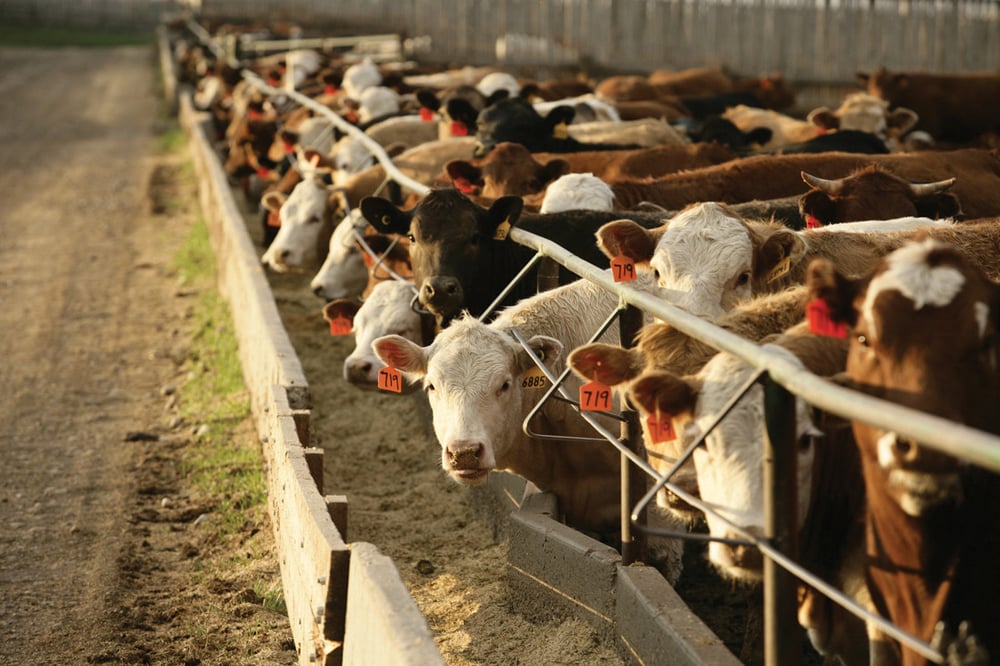
A new national survey of Canadian feedlots is providing the first comprehensive benchmark of management practices across the cattle feeding sector, offering valuable insight into how operations compare on feed, receiving protocols and growth-enhancing technologies.
The survey, which collected responses from 87 feedlots across seven provinces, was led by researchers from the University of Saskatchewan, the University of Guelph and the University of Manitoba, in partnership with Agriculture and Agri-Food Canada (AAFC).
According to Dr. Gabriel Ribeiro, associate professor and Saskatchewan Beef Industry Chair in the Department of Animal Science at the University of Saskatchewan, benchmarking provides producers with a practical tool for evaluating their own operations and identifying opportunities for improvement.
“Benchmarking helps producers understand how their management practices compare with industry averages and peer operations,” says Ribeiro. “It allows us to identify strengths, highlight gaps and focus research and extension efforts on the areas that can have the greatest impact on productivity and profitability.”
The project was supported through producer check-off dollars invested by the Beef Cattle Research Council (BCRC), along with funding from Agriculture and Agri-Food Canada through the Beef and Forage AgriScience Cluster under the Sustainable Canadian Agricultural Partnership.
Filling a knowledge gap
While benchmarking initiatives have previously been developed for Canada’s cow-calf sector, no similar national benchmark existed for feedlots.
The survey was designed to establish a baseline understanding of production and management practices used in Canada’s backgrounding and finishing sectors.
Researchers found significant differences based on both feedlot location and operation size, while also identifying several common practices across the industry.
Feed grains and byproducts
The survey confirmed regional differences in feed grain use.
Corn remains the primary feed grain in Eastern Canada, while barley continues to dominate in Western Canada. Researchers also noted increasing use of corn and wheat in western feeding programs.
The use of byproducts was widespread, with 85.4 per cent of feedlots reporting their inclusion in cattle diets.
Common byproducts included distillers dried grains with solubles (DDGS), potatoes, grain screenings and other feed ingredients that can help reduce feed costs while maintaining performance.
“With feed costs representing one of the largest expenses in a feedlot operation, producers are continually looking for opportunities to improve efficiency,” says Ribeiro. “The high level of byproduct use demonstrates how Canadian feedlots are adapting available feed resources to help manage costs.”
Grain processing remains an opportunity
One of the more notable findings involved grain processing evaluation.
Dry rolling was the most common grain-processing method used in finishing diets, followed by high-moisture storage and temper rolling.
While grain processing plays an important role in starch utilization, feed efficiency and digestive health, relatively few feedlots formally evaluate the effectiveness of their processing systems.
Only 24.5 per cent of respondents reported using measures such as processing index or per cent fines to assess grain processing, while another 22.2 per cent relied primarily on visual assessment.
“Grain processing has a direct impact on how efficiently cattle utilize feed,” says Ribeiro. “The survey suggests there may be opportunities for greater adoption of objective monitoring tools that can help producers optimize performance and reduce the risk of digestive upsets.”
Receiving protocols largely consistent
Researchers found receiving protocols were generally similar across feedlots regardless of location or size.
Nearly all respondents reported deworming incoming cattle, vaccinating for bovine respiratory disease (BRD) and administering antibiotic treatments when appropriate based on risk.
The use of vitamin supplementation at arrival was less common, with nearly two-thirds of respondents indicating they do not routinely provide injectable or drench vitamin products.
Feedlots reported handling a variety of cattle types, including weaned calves, backgrounded calves, grasser yearlings, dairy-cross calves and cull cows.
Technology adoption varies by feedlot size
The survey also examined adoption of growth-enhancing technologies.
Use of hormonal implants and ionophores was widespread among respondents, with 82.6 per cent reporting implant use and 94.4 per cent using ionophores. Just over half of respondents reported using beta-adrenergic agonists.
However, adoption rates declined significantly among feedlots with fewer than 500 head of capacity.
Only 42.1 per cent of smaller operations reported using implants, while 75 per cent used ionophores and none reported using beta-adrenergic agonists.
The survey also found that additional feed additives such as tylosin and melengestrol acetate (MGA) were more commonly used in larger feedlots.
“These differences highlight opportunities to better understand the barriers and decision-making factors influencing technology adoption in smaller operations,” says Ribeiro. “That information can help guide future extension programming and research efforts.”
Guiding future research and extension
Researchers say the benchmark provides more than a snapshot of current industry practices.
The information can help producers compare their own management systems against national trends while also identifying areas where additional research, knowledge transfer and extension support may be beneficial.
“This benchmark gives us a clearer picture of how Canadian feedlots operate today,” says Ribeiro. “It helps ensure future research investments and extension efforts are focused on addressing the industry’s most important challenges and opportunities.”
The full results will help guide future work aimed at improving feed efficiency, growth performance and overall competitiveness within Canada’s cattle feeding sector.
Share this article on




Latest News
-
October 17, 2026 Business Tools
Building a uniform cow herd through intentional genetic selection
-
October 16, 2026 News
AgKnow to be transferred to new non-profit organization
-
October 15, 2026 Innovation & Technology
New tool helps producers track crop water use
Cattle Report
Updated: October 16, 2026
Steers
Live: ---
Rail: 500.00 del
Heifers
Live: ---
Rail: 500.00 del
Choice Steers
Live: 220.00 (IA)*few
Rail: 345.00-355.00 (IA, NE)
Choice Heifers
Live: 220.00 (IA)*few
Rail: 345.00-355.00 (IA, NE)
Boner Cows
Over 500 lbs: 258.94
Canadian Dollar
$70.94 0.25
Livestock Price Insurance Index
| Expiry | Fed | Feeder | Calf |
|---|---|---|---|
| 08-Feb-27 | 290 | 458 | -- |
| 08-Mar-27 | 290 | 454 | -- |
| 05-Apr-27 | 294 | 452 | -- |
| 03-May-27 | 300 | 450 | -- |
| 31-May-27 | 306 | 456 | -- |
| 28-Jun-27 | 302 | 456 | -- |
| - | - | - | - |
Last Updated on October 15, 2026