Live: ---
Rail: 491.75-499.75 FOB feedlot (last week)

{{ weatherTemp }}°C
{{ weatherCity }}

AB Direct - Steers
AB Direct - Heifers
Live: ---
Rail: 491.75-499.75 FOB feedlot (last week)
Rail: 491.75-499.75 FOB feedlot (last week)
US Trade- Steers
Live: 218.00-222.00 (NE, IA), 220.00-222.00 (TX, KS) last week
Rail: 345.00-350.00 (NE, IA) last week
Rail: 345.00-350.00 (NE, IA) last week
US Trade - Heifers
Live: 218.00-222.00 (NE, IA), 220.00-222.00 (TX, KS) last week
Rail: 345.00-350.00 (NE, IA) last week
Rail: 345.00-350.00 (NE, IA) last week
Canadian Dollar
$72.14
0.19
0.19
April 28, 2026
Health & Production
Eight keys to grazing management
Effective grazing management is one of the most powerful tools beef producers can use to enhance cattle performance, improve pasture productivity and support the long-term sustainability of their operation.
Whether refining an existing plan or starting from scratch, these key grazing management facts can help get the most out of every acre.
1. Balance forage supply and demand
Matching animal numbers to forage availability prevents overgrazing and maintains pasture longevity. A commonly used guideline is the “take half, leave half” principle, meaning roughly 50 per cent of forage biomass should remain after grazing.
This helps maintain plant vigour and supports regrowth, though adjustments may be needed depending on region and conditions.
2. Provide rest during the growing season
Plants need time to recover after grazing. Rest allows root systems to rebuild and strengthens plants to withstand future grazing pressure.
Without adequate recovery, pasture productivity declines over time. Rotational grazing systems help support this by allowing paddocks time to regrow between grazing periods.
3. Defer grazing during sensitive periods
Certain stages of plant growth are more vulnerable to stress. Grazing too early in the spring or during key reproductive stages can reduce plant vigour. Delaying grazing during these critical periods helps maintain long-term pasture health and resilience.
4. Manage for uniform livestock distribution
Cattle tend to overgraze areas near water and shade if not managed. Encouraging more uniform distribution improves pasture use and reduces patch overgrazing.
Placing salt and mineral away from water sources can help draw cattle into underused areas. Ideally, water should be available within 600 to 800 feet of all parts of a paddock to support consistent grazing patterns.
5. Choose the grazing system that fits your operation
Common grazing systems in Canada include continuous and rotational grazing. The best choice depends on available resources, management goals and landscape.
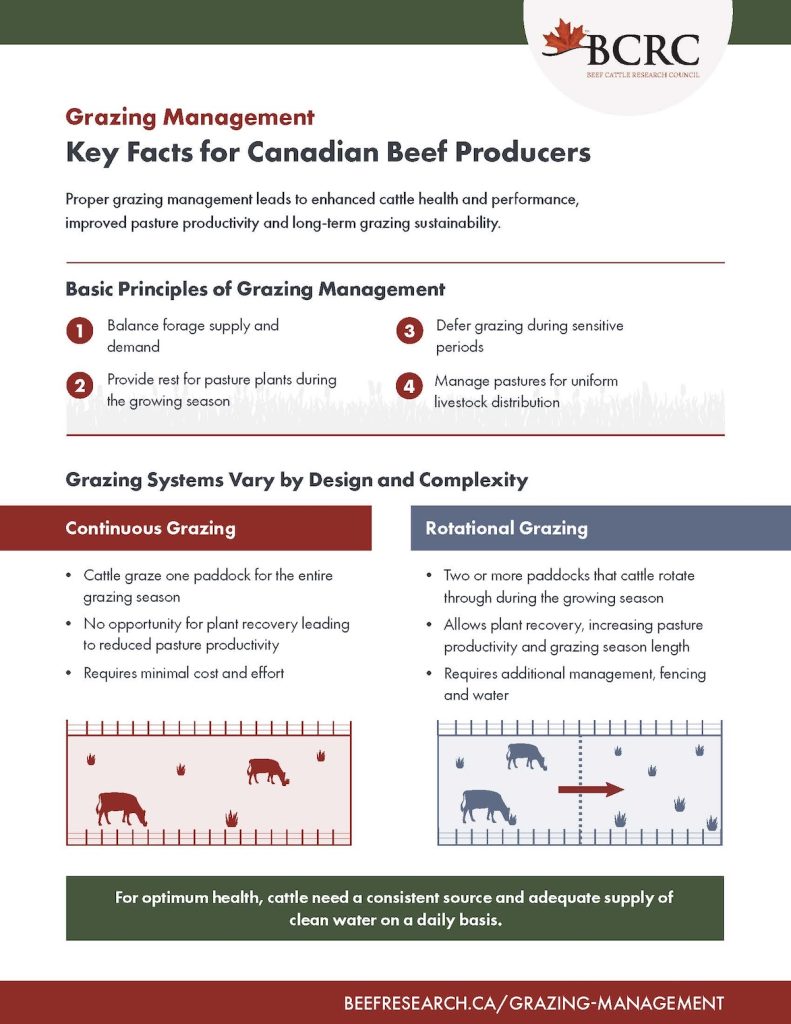
Continuous grazing
• One paddock grazed all season
• Lower cost and minimal management
• Can reduce pasture productivity due to limited rest
Rotational grazing
• Two or more paddocks grazed in sequence
• Supports plant recovery and improved productivity
• Can extend the grazing season
• Requires more planning, fencing and water infrastructure
Monitor water quality and supply
Clean, reliable water is essential for herd health and performance. Poor water quality can lead to health issues or even mortality.
Research shows calves with access to pumped water may gain 16 to 18 pounds more over a grazing season compared to those drinking directly from a dugout. Water quality should be tested regularly, as it can change throughout the summer.
Consider grazing legumes
Legumes such as alfalfa and clover can improve forage quality but may increase bloat risk. Newer bloat-safe options, such as sainfoin, offer improved persistence and yield.
Including 15 per cent or more sainfoin in a stand with alfalfa can help reduce bloat risk while maintaining nutritional benefits.
Evaluate carrying capacity regularly
Carrying capacity refers to the amount of forage available to support grazing animals on a given pasture. Regular evaluation helps ensure stocking rates remain sustainable.
The Beef Cattle Research Council’s Carrying Capacity Calculator can assist producers in estimating capacity using both provincial guidelines and field-based measurements.
What this means for your grazing plan
Grazing management is both an art and a science. While core principles remain consistent, every operation is different based on climate, soil, forage species, herd size and production goals.
Applying these fundamentals can help improve pasture resilience, support herd performance and build a more sustainable grazing system over the long term.
Share this article on


Latest News
-
August 31, 2026 Health & Production
Balancing cost, labour, and nutrition in cattle mineral programs
-
August 28, 2026 Issues & Insights
Trade uncertainty shaping investment decisions, industry leaders say
-
August 28, 2026 Health & Production
BCRC highlights grazing management resources for summer
Cattle Report
Updated: August 31, 2026
Steers
Live: ---
Rail: 491.75-499.75 FOB feedlot (last week)
Heifers
Live: ---
Rail: 491.75-499.75 FOB feedlot (last week)
Choice Steers
Live: 218.00-222.00 (NE, IA), 220.00-222.00 (TX, KS) last week
Rail: 345.00-350.00 (NE, IA) last week
Choice Heifers
Live: 218.00-222.00 (NE, IA), 220.00-222.00 (TX, KS) last week
Rail: 345.00-350.00 (NE, IA) last week
Boner Cows
Over 500 lbs: 313.12
Canadian Dollar
$72.14 0.19
Livestock Price Insurance Index
| Expiry | Fed | Feeder | Calf |
|---|---|---|---|
| 23-Nov-26 | 266 | 414 | -- |
| 21-Dec-26 | 268 | 408 | -- |
| 18-Jan-27 | 266 | 406 | -- |
| 15-Feb-27 | 266 | 398 | -- |
| 15-Mar-27 | 266 | 398 | -- |
| 12-Apr-27 | 274 | 396 | -- |
| 10-May-27 | 280 | 402 | -- |
Last Updated on August 27, 2026