Live: ---
Rail: ---

{{ weatherTemp }}°C
{{ weatherCity }}

AB Direct - Steers
AB Direct - Heifers
Live: ---
Rail: ---
Rail: ---
US Trade- Steers
Live: ---
Rail: ---
Rail: ---
US Trade - Heifers
Live: ---
Rail: ---
Rail: ---
Canadian Dollar
$70.76
0.07
0.07
September 29, 2026
Business Tools
Alberta study tests virtual fencing under ranch conditions
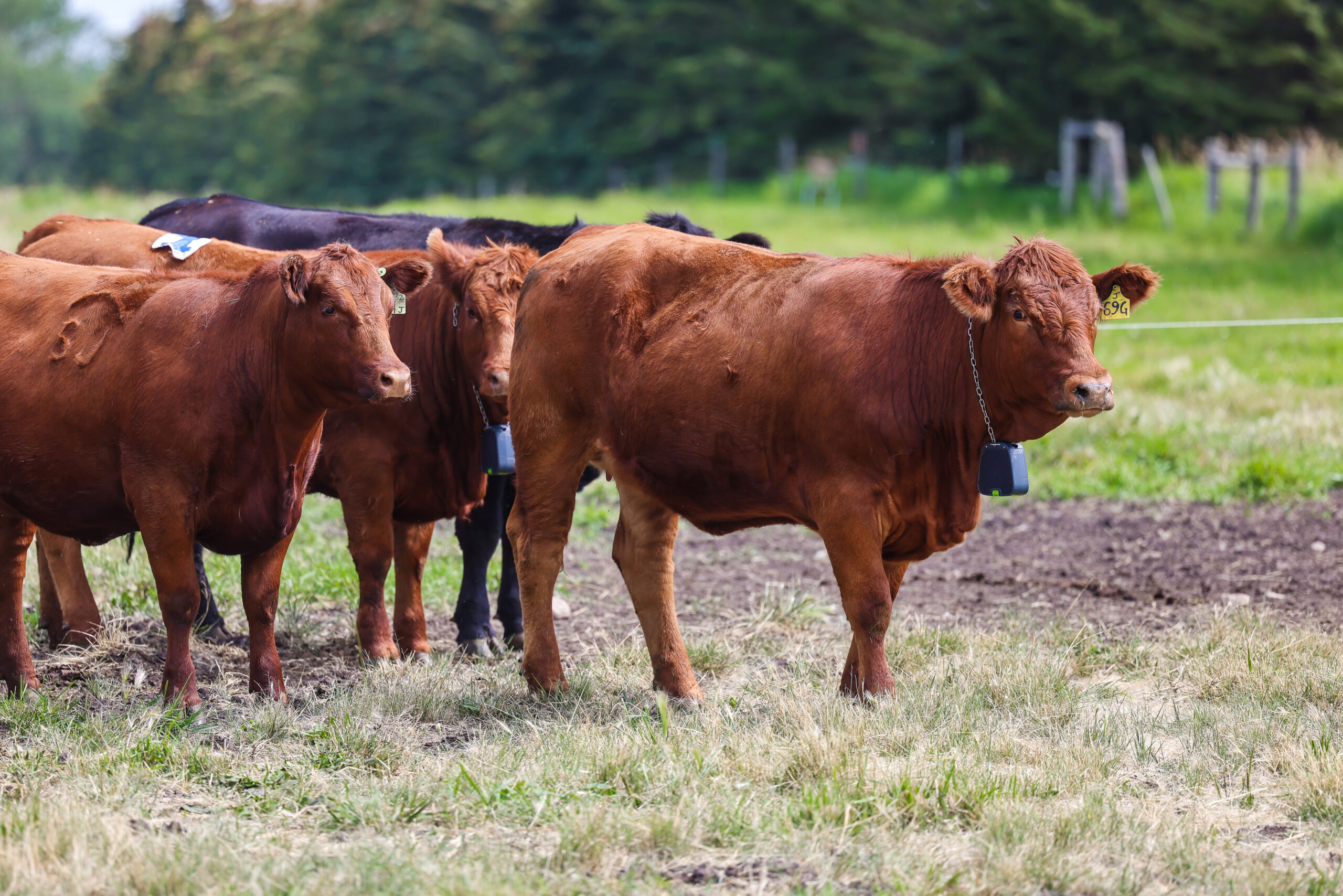
New Alberta research will test how virtual fencing performs with cow–calf pairs and yearlings under working ranch conditions.
Results Driven Agriculture Research (RDAR) is supporting trials of Halter’s virtual fencing technology led by the Technology Access Centre for Livestock Production at Olds College of Agriculture & Technology. The research will examine how the collars perform in Alberta terrain and climate, with a focus on connectivity, usability and cattle behaviour.
Currently, only two systems are available to Alberta beef producers: Gallagher eShepherd and Halter, according to RDAR. The organization has supported trials of Gallagher’s eShepherd collars in both research and on-farm environments since late 2025. The new research will expand on this foundation by evaluating the Halter technology.
The project will test the collars on 35 cow-calf pairs and 35 yearslings at a partner producer’s operation, as well as 80 cow-calf pairs on Olds College land. Producers will be involved in implementing the system and providing feedback throughout the trial.
Virtual fencing has the potential to provide producers with another option for managing rotational grazing and, in some situations, reduce the need for physical fencing. The trials are designed to generate Alberta-specific data on the technology’s reliability and its impact on labour requirements and day-to-day cattle management.
Real-world data to support adoption, reduce uncertainty around labour and management, and build confidence in system reliability and animal response is important in understanding the cost benefit of virtual fencing, says RDAR. The new research targets results that to guide technology refinement, extension programming, and responsible precision livestock adoption.
Leave a Comment

Latest News
-
September 29, 2026 Business Tools
Alberta study tests virtual fencing under ranch conditions
-
September 28, 2026 Checking in with ABP
#AllForTheBeef: A busy summer with ABP
-
September 28, 2026 Current Markets & Forecasts
Canfax weekly article | Report for the week of September 28, 2026
Cattle Report
Updated: September 29, 2026
Steers
Live: ---
Rail: ---
Heifers
Live: ---
Rail: ---
Choice Steers
Live: ---
Rail: ---
Choice Heifers
Live: ---
Rail: ---
Boner Cows
Over 500 lbs: 275.58
Canadian Dollar
$70.76 0.07
Livestock Price Insurance Index
| Expiry | Fed | Feeder | Calf |
|---|---|---|---|
| 21-Dec-26 | 284 | 444 | -- |
| 18-Jan-27 | 282 | 444 | -- |
| 15-Feb-27 | 280 | 434 | -- |
| 15-Mar-27 | 280 | 432 | -- |
| 12-Apr-27 | 286 | 430 | -- |
| 10-May-27 | 294 | 432 | -- |
| 07-May-27 | 298 | 438 | -- |
Last Updated on September 24, 2026

Add abpdaily.com to your home screen
Tap the menu button next to the address bar or at the bottom of your browser.
Select ‘Install’ or ‘Add to Homescreen’ to stay connected.
Share this article on
About the Author
Brad Brinkworth has a deep background in strategic communications and content, working across agriculture in Alberta and beyond. He grew up with extended family involved in both crop and livestock farming, and holds a degree in Journalism and Communications from the University of Minnesota. Brad enjoys telling the story of agriculture and creating clear, purposeful content that connects with producers. He and his family are based in Calgary.