Live: ---
Rail: 487.00-496.75 FOB feedlot (last week)

{{ weatherTemp }}°C
{{ weatherCity }}

AB Direct - Steers
AB Direct - Heifers
Live: ---
Rail: 487.00-496.75 FOB feedlot (last week)
Rail: 487.00-496.75 FOB feedlot (last week)
US Trade- Steers
Live: 228.00 (NE, IA) 230.00 (TX, KS) last week
Rail: 358.00 (IA, NE) last week
Rail: 358.00 (IA, NE) last week
US Trade - Heifers
Live: 228.00 (NE, IA) 230.00 (TX, KS) last week
Rail: 358.00 (IA, NE) last week
Rail: 358.00 (IA, NE) last week
Canadian Dollar
$71.36
0.21
0.21
April 16, 2026
Checking in with ABP
Why a tighter calving window matters: more calves, more weight, more profit
A tighter calving season can make a noticeable difference in calf performance and overall herd profitability. Concentrating births into a defined period increases average weaning weight, improves marketing opportunities, and can simplify herd management. If a tighter calving window could add pounds at weaning and dollars to your bottom line without extra cost, what’s holding your herd back?
It’s difficult to change overnight, but if you are persistent and take one step at a time you will see results!
Jack Lalanne
Tightening the window: How it works
The analysis looked at nine benchmark farms and modelled what happens when the calving season is tightened to three defined cycles: 70 per cent calving in the first cycle, 20 per cent in the second, and 10 percent in the third.
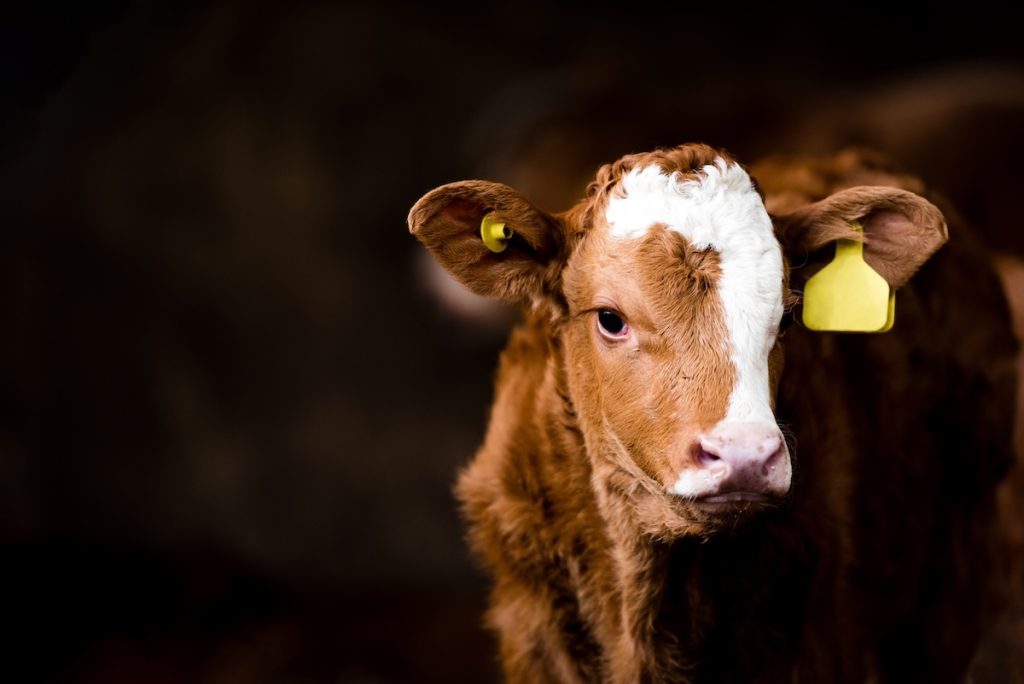
The transition was assumed to take place gradually over five years. Bulls were pulled five days earlier each year, and heifers were bred two to four weeks ahead of the cow herd. Importantly, this strategy did not require additional cash expenses. The primary expected benefit was heavier weaning weights. The goal was to avoid a surge in open cows.
No extra cash expense is needed — just management changes like pulling bulls earlier and front-loading heifers.
Dollars on the ground
Revenue gains from a tighter calving season ranged from $5 per cow to $30 per cow, depending on the farm’s starting point (data was from the 2020 production year – with current prices these values would be higher). Operations that began with a long calving season saw the largest benefits, while those already close to the 70-20-10 distribution saw only modest improvements.
Small changes can produce big results – but the areas of highest leverage are often the least obvious.
Peter Senge
For example, farm ON-4 already had more than 85 per cent of its herd calve within the first two cycles. By shifting to the 70-20-10 target, revenue was projected to rise by only about $5 per cow. In contrast, farms with more prolonged calving seasons were able to capture much larger gains as heavier average weaning weights improved total revenue.
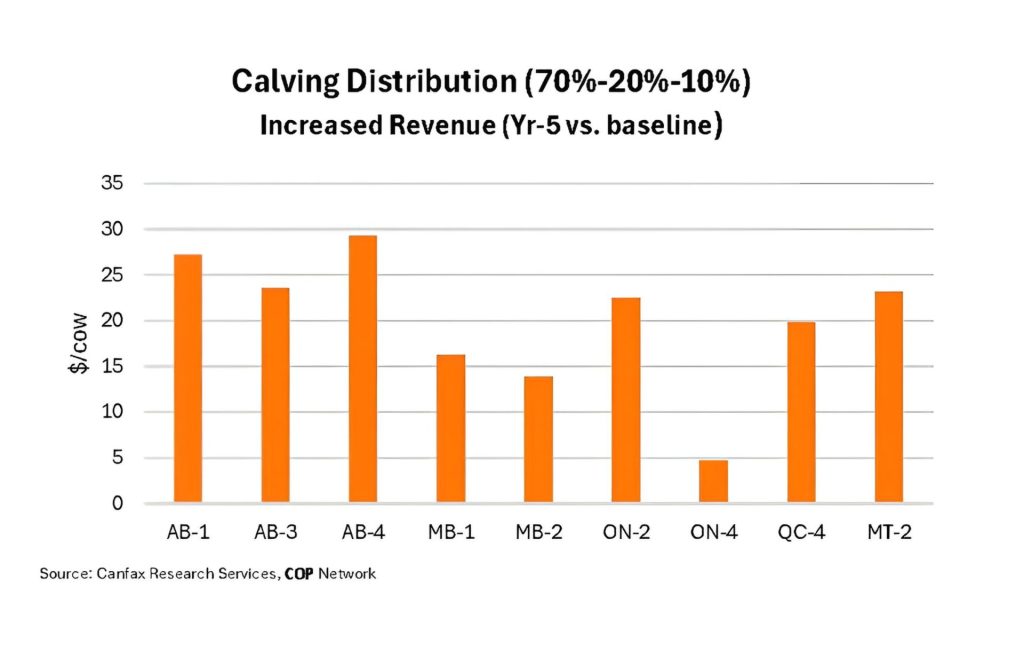
Chasing a tighter calving window may not pay off if you already have most calves born in the first two cycles; but farms with long calving seasons stand to gain the most from shifting to a shorter window.
What this means for you
For producers already managing a short calving period, the effort of pushing for even more concentration may not justify the limited gains. However, for those with a longer calving season, the potential to add significant revenue without additional costs makes a strong case for gradually tightening the window.
Management practices like pulling bulls earlier and front-loading heifers are simple adjustments that can help shift calving distribution over time. Tracking calving dates also provides valuable records to measure progress and evaluate the payoff.
Learn how to keep records on calving distribution here, and estimate the value of calving distribution here. More information about the economics of calving distribution and how to transition to a shorter calving season can be found here.
Key takeaways
- Moving toward a 70-20-10 calving distribution can increase revenue by $5 to $30 per cow, depending on the baseline.
- The main benefit of a tighter calving window is heavier weaning weights, without added expenses.
- Farms with already short calving seasons see limited gains, while those that are currently more prolonged can capture much larger benefits.
- Gradual changes — such as pulling bulls earlier each year and breeding heifers ahead of the cow herd — can successfully transition a herd over five years.
More information from the COP Network is available from Canfax Research Services. Canfax is funded by Memberships, go to www.canfax.ca to subscribe.
Share this article on



Latest News
-
October 26, 2026 Business Tools
Five things to check on cattle mineral supplement labels
-
October 26, 2026 Current Markets & Forecasts
Canfax report for the week of October 26, 2026
-
October 26, 2026 Checking in with ABP
Working groups deliver recommendations on industry issues
Cattle Report
Updated: October 26, 2026
Steers
Live: ---
Rail: 487.00-496.75 FOB feedlot (last week)
Heifers
Live: ---
Rail: 487.00-496.75 FOB feedlot (last week)
Choice Steers
Live: 228.00 (NE, IA) 230.00 (TX, KS) last week
Rail: 358.00 (IA, NE) last week
Choice Heifers
Live: 228.00 (NE, IA) 230.00 (TX, KS) last week
Rail: 358.00 (IA, NE) last week
Boner Cows
Over 500 lbs: 252.50
Canadian Dollar
$71.36 0.21
Livestock Price Insurance Index
| Expiry | Fed | Feeder | Calf |
|---|---|---|---|
| 18-Jan-27 | 292 | 470 | -- |
| 15-Feb-27 | 292 | 460 | -- |
| 15-Mar-27 | 292 | 460 | -- |
| 12-Apr-27 | 298 | 446 | -- |
| 10-May-27 | 304 | 458 | -- |
| 07-Jun-27 | 310 | 462 | -- |
| 05-Jul-27 | 302 | -- | -- |
Last Updated on October 22, 2026